Painting Contract Templates — Essential Clauses Every Contractor Needs
17 April 2026 · ProPainterTools
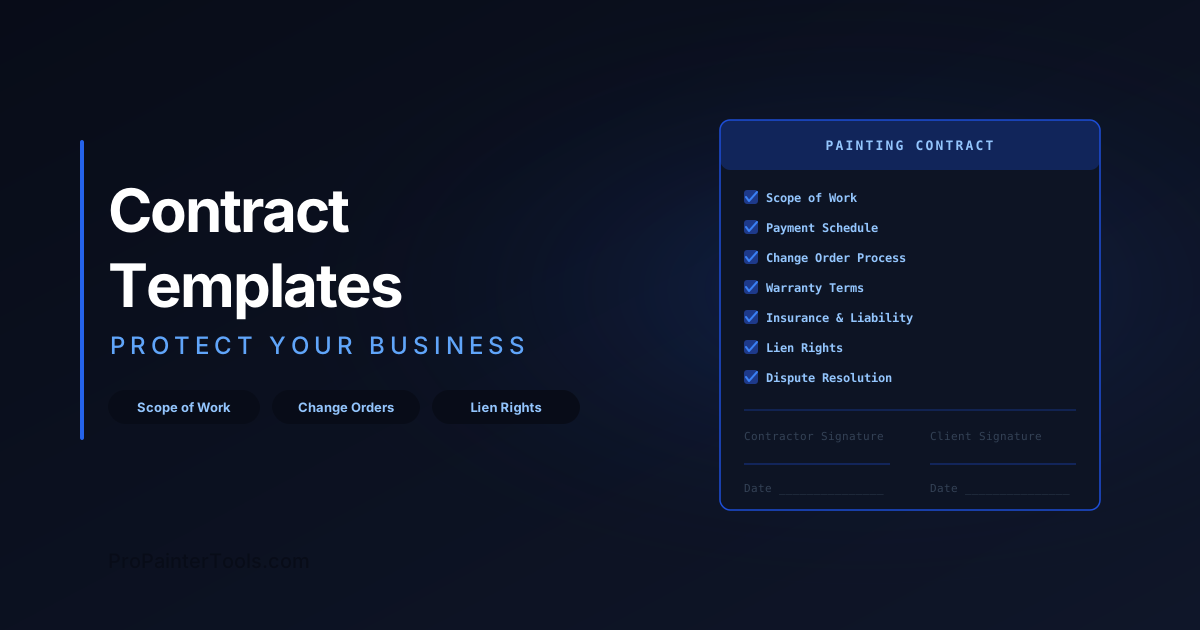
Painting Contract Templates: Essential Clauses Every Contractor Needs
A verbal agreement is worth nothing when a client disputes the finish quality, refuses final payment, or claims you damaged their property. A well-written painting contract is not a sign of distrust — it is the professional standard that protects both parties, sets clear expectations before work begins, and gives you a legal basis for resolving disputes without going to court. This guide covers the essential clauses every painting contract must contain, what language to use, and the provisions that prevent the most common disputes in the trade.
Why Contracts Prevent Disputes (Not Just Resolve Them)
Most painting disputes are not about quality — they are about expectations that were never written down. The client expected three coats; you quoted two. The client assumed you would move all furniture; you assumed they would. The client thought "touch up" meant repaint the entire wall; you meant spot-repair visible damage only.
A contract forces the specification conversation to happen before the job starts, not after. Every clause that seems unnecessary when the relationship is good becomes essential the moment something goes wrong.
1. Scope of Work
The scope of work is the most important section of your contract. It must be specific enough that a third party reading it could determine whether the work was completed as agreed.
Include:
- Exact surfaces to be painted (room by room, or by elevation for exterior)
- Number of coats per surface
- Specific products to be used (manufacturer, product name, sheen level)
- Surface preparation method (reference the standard: SSPC-SP3, hand sand, wash and prime)
- What is explicitly excluded — this is as important as what is included
Scope exclusions to state explicitly:
- Moving of furniture (state who is responsible, or that furniture must be cleared before crew arrives)
- Repair of existing substrate damage beyond normal filling and sanding (holes larger than X inches, water damage, rot)
- Removal of wallpaper
- Painting of surfaces not listed (new shelving installed after quote, ceiling not in scope)
- Work dependent on third-party completion (electrician patching, plasterer skim coat)
Example scope language:"Contractor will apply one coat of Brand Product primer and two coats of Brand Product in Sheen to all walls in the main bedroom (approx. 280 SF). Ceiling, trim, and closet interior are excluded from this scope. Client is responsible for removing all wall hangings, mirrors, and personal items before work commences."
See our estimating guide for how the scope drives the production rate calculation and material takeoff that form the basis of your price.
2. Products and Materials
Specify the exact products to be used. This protects you from being accused of substituting inferior materials and protects the client from bait-and-switch on quality.
Include:
- Manufacturer and product name for every coating
- Sheen level (flat, eggshell, satin, semi-gloss, gloss)
- Colour reference (paint brand colour code, not just colour name) — see our colour consultation guide for how to document LRV, undertones, and approval light source to prevent post-paint colour disputes
- Who supplies the paint — contractor-supplied or owner-supplied
Owner-supplied paint clause: If the client supplies their own paint, include a clause explicitly stating that you accept no responsibility for the performance, coverage, or appearance of client-supplied materials, and that additional labour costs from inadequate coverage will be billed as a change order.
3. Payment Terms and Schedule
Payment terms define when you get paid and what happens if you do not. Vague payment terms ("upon completion") create leverage for clients to delay payment indefinitely under the guise of a punch list dispute.
Standard payment structure for painting work:
- Residential repaint (1–3 day job): 30–50% deposit at contract signing, balance due on day of completion before crew leaves the site
- Larger residential or light commercial (1–2 week project): 30% deposit, progress payment(s) tied to milestones, final 10–15% on client sign-off of completion
- Commercial or industrial (multi-week): Monthly progress billing against percentage complete, retainage of 5–10% released on final acceptance
Late payment clause: Specify the interest rate on overdue invoices (typically 1.5% per month = 18% annual) and the point at which work is suspended for non-payment. Most states allow contractors to charge reasonable interest on overdue accounts — include this right explicitly.
Returned payment clause: Specify a returned cheque fee (typically $35–$50) and require cleared funds before work resumes.
4. Change Orders
Change orders are the mechanism for handling any work that falls outside the original scope. Without a written change order process, additional work becomes a source of dispute — the contractor believes they are owed more money; the client believes the extra work was included.
Change order clause language:"Any work requested by the Client that falls outside the scope defined in this contract will be performed only upon written change order signed by both parties. Verbal authorisations for additional work are not binding. Change order pricing will reflect the current labour rate of $X/hr plus materials at cost plus X% overhead."
Never start out-of-scope work without a signed change order. This is the single most common way painting contractors erode their margins. A client's verbal "just do it while you're here" is worth nothing.
5. Warranty Terms
A clearly defined warranty protects you from open-ended liability while giving the client a legitimate assurance of quality.
What a standard painting warranty covers:
- Peeling, flaking, or adhesion failure of the applied coating not caused by substrate movement, moisture intrusion, or third-party damage
- Typically 1–2 years for residential interior, 2–3 years for exterior
What a warranty must explicitly exclude:
- Substrate movement (wood expansion/contraction, settling cracks)
- Moisture damage from leaks, condensation, or flooding after project completion
- Damage caused by third parties, cleaning products, or improper maintenance
- Surface preparation deficiencies that were visible and noted prior to work or that resulted from conditions outside contractor control (e.g., substrate not meeting moisture content requirements at time of application)
- Any surfaces where the client supplied materials
Warranty condition: State that the warranty is conditional on the client notifying you in writing within the warranty period and allowing inspection before any remedial work is performed by a third party. A client who hires another contractor to repaint before notifying you of a defect voids the warranty.
For projects involving pre-1978 buildings where lead paint was present, your warranty should be separate from RRP compliance documentation — see our EPA Lead-Safe RRP guide for the records you are required to keep.
6. Insurance and Liability
Your contract should state the types and minimum amounts of insurance you carry and require the client to acknowledge this.
Minimum insurance for a painting contractor:
- General liability: $1M per occurrence / $2M aggregate is the residential standard; commercial work typically requires $2M/$4M
- Workers' compensation: Required in all states for any employees; some states require it for sole proprietors working on certain contract types
- Commercial auto: If company vehicles are used to transport employees or equipment
Limitation of liability clause: Limit your total liability to the contract value, excluding gross negligence and wilful misconduct. This is standard professional services language and is enforceable in most jurisdictions.
Property damage clause: Define your responsibility for incidental property damage during the work (paint drips on flooring, minor wall scuffs from ladders) versus pre-existing damage that you documented at walkthrough. Always photograph the work area before starting and keep those photos for three years.
7. Access and Site Conditions
Include provisions for:
- Client responsibility to provide unobstructed access to all surfaces in scope by the agreed start date
- Right to suspend or reschedule work if site conditions prevent safe or quality application (rain, temperature outside specification, wet substrate) — see our moisture testing guide for the substrate conditions that justify a stop-work
- Storage of materials and equipment on-site between shifts for multi-day projects
- Utility access (water for cleanup, power for sprayers and lighting)
8. Lien Rights
In most US states, painting contractors have the right to file a mechanic's lien (also called a construction lien or materialman's lien) against the property if payment is not made. A lien clouds the property title and prevents sale or refinancing until resolved.
Include a clause stating:"Contractor reserves all rights to file a mechanic's lien or materialman's lien against the project property in the event of non-payment in accordance with State lien statutes. Preliminary lien notice will be served as required by State law."
In states with notice requirements (California, Texas, Florida, and many others), you must serve a preliminary lien notice within a specific window after starting work — often 20 to 30 days. This notice requirement applies even if you ultimately get paid without dispute. Failing to serve the notice on time can extinguish your lien rights entirely. Consult a construction attorney in your state to ensure your standard contract preserves lien rights correctly.
9. Dispute Resolution
Litigation is expensive and slow. A dispute resolution clause can require mediation before litigation, saving both parties significant cost and time.
Recommended approach:"In the event of a dispute arising from this contract, the parties agree to first attempt resolution through good-faith negotiation. If unresolved after 30 days, the dispute will be submitted to non-binding mediation through local mediation service before either party may pursue litigation."
Also specify the governing law (your state) and jurisdiction (your county) for any litigation that does proceed. This prevents a client in another state from filing suit in a distant jurisdiction.
Frequently Asked Questions
Do I need a lawyer to write my painting contract? For your first contract template, having a construction attorney review it for your state is money well spent — typically $300–$600 for a review and redline. Once you have a solid template, you can modify it yourself for each job. The lien rights clause in particular is highly state-specific and should be professionally drafted.
Can I use a digital signature on my contracts? Yes. Electronic signatures are legally binding under the Electronic Signatures in Global and National Commerce Act (E-SIGN) in the US and equivalent legislation in most countries. Platforms like DocuSign, Adobe Sign, and HelloSign provide an audit trail that strengthens your position in a dispute.
What should I do if a client refuses to sign a contract? Do not start the work without a signed contract. A client who refuses to sign is a client who does not intend to be held to their commitments. The rare exception is a long-standing client relationship with a consistent payment history — in which case, at minimum, confirm scope and price via email and retain the thread.
How do I handle a client who wants to change the scope mid-job? Stop, write the change order, get it signed, then proceed. If the change is minor (one additional door), some contractors absorb it as goodwill — but document it in writing either way ("we have included painting of the utility room door at no additional charge"). Undocumented goodwill becomes an expectation for every future job.
This guide provides general information only and does not constitute legal advice. Consult a licensed attorney in your state before finalising your contract templates, particularly for lien rights and liability limitation clauses.
For the payment and collections workflow that operates alongside your contract — invoice structure, progress billing, overdue escalation, and mechanic's lien filing — see our invoicing and collections guide. For new construction subcontract-specific terms including lien waivers and retainage, see our new construction painting guide. For the licence and insurance requirements that should be referenced in your contracts, see our painting contractor licensing guide.
