New Construction Painting — GC Subcontracts, Scheduling, and Production Methods
22 April 2026 · ProPainterTools
New Construction Painting: GC Subcontracts, Scheduling, and Production Methods
New construction painting is a different business from residential repaint. The client relationship is with a general contractor (GC), not a homeowner. The scope is defined by architectural specifications and a paint schedule, not a site visit. The schedule is shared with 15 other trades on a critical path. Production rates are higher because surfaces are clean and accessible. But the payment cycle is longer, retainage is withheld, and the lien waiver process is mandatory. This guide covers the differences that matter for a painting contractor considering or scaling new construction work.
The GC Relationship and Subcontract Structure
In new construction, the painting contractor is a subcontractor to the GC. The GC holds the prime contract with the owner; subcontractors sign subcontracts directly with the GC. The subcontract governs your rights, obligations, and payment — more strictly than any residential contract you will encounter.
Before signing a GC subcontract, review:
- Scope definition: Is the scope attached as a specification, a drawing set reference, or a narrative description? Ambiguous scope in new construction is resolved against the subcontractor — if it is not explicitly excluded, you may be expected to include it.
- Paint schedule: The architectural paint schedule specifies product type, sheen, colour, and number of coats by surface. Review it against your bid before signing. Substitutions require GC and architect approval.
- Pricing basis: Is the contract lump sum (fixed), unit price (per room, per door, per linear metre), or time-and-materials? Lump sum is most common in new construction; unit price is used when the quantity of rooms or units is not yet fixed at bid time.
- Payment terms: New construction subcontracts typically specify monthly progress billing, 30-day payment terms, and retainage of 5–10%. The payment chain is GC-to-sub, not owner-to-sub — if the GC is not paid by the owner, most subcontracts include a "pay when paid" clause that delays your payment accordingly. "Pay when paid" is enforceable in most states; "pay if paid" (conditional on GC receipt) is enforceable in some states and voidable in others.
- Schedule and liquidated damages: Is there a project completion date and a liquidated damages clause? Liquidated damages charge the GC (and flow down to subs) a fixed daily amount for project delays. Painting schedule slippage caused by other trades is common; understand who bears the risk.
- Insurance requirements: Commercial new construction subcontracts typically require $2M/$4M GL, workers' compensation, and commercial auto — and often require naming the GC and owner as additional insureds.
Scheduling and Trade Coordination
New construction painting occurs in two distinct phases, each with different production conditions, scope, and crew requirements.
Phase 1 — Rough / Structural Phase (Pre-Drywall Finish)
In some new construction, painting of structural steel, mechanical rooms, or fire-rated assemblies occurs before drywall is complete. This phase may include:
- Primer on structural steel (often intumescent primer for fire rating)
- Painting of mechanical and electrical rooms where finish requirements differ from occupied space
- Fire-rated paint on specific assemblies per the architectural plans
Coordination: This phase follows structural, mechanical, and electrical rough-in. Your access depends on those trades completing their work and passing inspections. Confirm inspection status before mobilising.
Phase 2 — Finish Phase (After Drywall and Trim)
The primary painting scope. Phasing within this stage:
- Prime walls and ceilings — after drywall is taped, mudded, and sanded; before trim is installed (in many builds)
- Paint trim — after trim is installed and caulked, before floors are finished
- Finish walls and ceilings — final coat after trim is painted, floors are protected
- Touch-up — after all trades complete their finish work and before occupancy inspection
The critical dependency: You cannot apply finish coats if other trades are still generating dust (sanding, cutting, grinding). Work with the GC's schedule coordinator to confirm the sequence. On multi-unit projects (apartments, townhouses), you may be able to stagger units while later phases continue in earlier units.
Environmental conditions: New construction HVAC may not be operational during painting. Temperature and humidity requirements still apply (paint manufacturer's minimum 10°C, maximum 35°C, maximum 85% RH for latex). Confirm with the GC whether temporary heat or dehumidification is provided during painting — and who pays for it. Include this in your bid if it is your responsibility.
Painter-Furnished vs Owner-Furnished Materials
In new construction, the specification may designate materials as:
Painter-furnished (PF): The painting subcontractor supplies all materials and includes them in the bid price. Material cost is typically 15–25% of the total contract in new construction. You control product quality, delivery, and scheduling.
Owner-furnished, contractor-installed (OFCI): The owner or GC purchases and delivers specified products; you apply them. Your contract covers labour only. OFCI shifts material cost risk to the owner but also reduces your control — product substitutions, late delivery, and wrong quantities are the owner's problem, but your schedule may still be affected.
Architect-specified product: Common in commercial new construction. The specification names a specific product (e.g., "Sherwin-Williams ProMar 200, flat, colour per schedule") — you must use that product unless you submit a formal substitution request with equivalent product data, and the architect approves in writing. Unilateral substitution on a specified product is a contract breach.
Bidding tip: When bidding painter-furnished, confirm the paint schedule lists colours and sheen by surface — not just generic descriptions. Tinted gallons cost more than factory-coloured gallons; dark colours may require additional coats beyond what is standard.
Production Approach for New Construction
New construction painting is faster per square metre than repaint because surfaces are clean, continuous, and accessible. Production approach differs accordingly.
Spray-and-backroll (prime coat): For wall and ceiling prime on new drywall, airless spray followed by immediate backrolling is the production standard. Spray applies product at high speed; backrolling works product into the surface and produces a uniform texture. A two-person crew (one spraying, one rolling) can prime 500–800m² per day on open residential floors.
Finish coats — spray-only vs spray-and-backroll: On higher-sheen finishes (eggshell, satin), backrolling the finish coat is advisable on textured or irregular drywall — texture variation produces sheen variation that is visible in raking light. On smooth drywall with low-sheen finishes, spray-only finish is acceptable.
Masking and protection: New construction requires masking hardware, windows, and floors before finish coats. Hardware is typically not installed until after painting — confirm with the GC's schedule. Pre-hung door frames are common; the door slabs are often stacked in a room for spray-painting (all doors removed and sprayed flat), then re-hung.
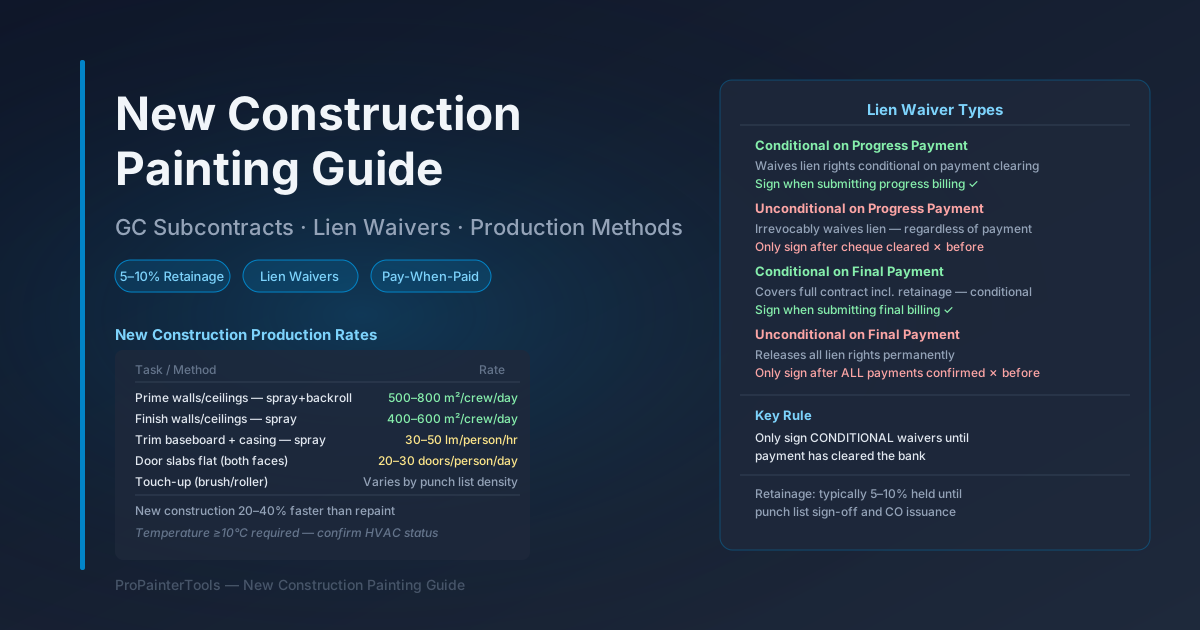
Production rates for new construction:
| Task | Method | Rate |
|---|---|---|
| Prime walls/ceilings | Spray + backroll | 500–800 m²/crew/day |
| Finish walls/ceilings | Spray | 400–600 m²/crew/day |
| Trim (baseboard, casing, doors) | Spray flat / rehang | 30–50 lm/person/hr |
| Door slabs (spray flat) | Airless, both faces | 20–30 doors/person/day |
| Touch-up | Brush/roller | Varies by density |
Lien Waivers
Lien waivers are standard in new construction payment. A lien waiver is a document signed by the subcontractor confirming that, in exchange for a specified payment, the sub waives its right to file a mechanic's lien against the property for that payment amount.
Types:
- Conditional lien waiver on progress payment: Waives lien rights for the period covered, conditioned on the payment actually clearing. Sign this when submitting a progress pay application; do not sign an unconditional waiver until the cheque has cleared.
- Unconditional lien waiver on progress payment: Irrevocably waives lien rights for the covered period regardless of whether payment clears. Only sign after confirmed payment receipt.
- Conditional lien waiver on final payment: Covers the entire contract including retention; conditioned on final payment clearing.
- Unconditional lien waiver on final payment: Irrevocably releases all lien rights. Only sign after all payments — including retainage — are confirmed received.
Practical rule: Only sign conditional waivers until payment clears. Never sign an unconditional waiver in exchange for a promise of payment.
Punch List and Final Completion
New construction punch lists are generated by the GC and architect after a substantial completion inspection. All outstanding items — paint touch-ups, colour corrections, missed areas — are documented. The punch list is typically the last checkpoint before retainage release.
Punch list management:
- Walk the project yourself before the formal punch list inspection — identify and address obvious items proactively
- Document your punch list completion with photos dated to the completion day
- Get written confirmation from the GC that the punch list is complete (email is sufficient)
- Track retainage release against punch list sign-off — do not allow "final" and retainage release to drift apart
Warranty Language
New construction painting warranties are more formal than residential repaint warranties because the project documentation trail is complete.
Standard painting warranty provision:
"Contractor warrants that all painting work will be free from defects in workmanship for a period of 1–2 years from the date of substantial completion. This warranty covers peeling, flaking, and adhesion failure attributable to faulty application. It does not cover: (a) normal fading or chalking attributable to the specified coating; (b) damage attributable to substrate movement, settlement, or moisture intrusion not caused by the painting contractor; (c) coating failures on surfaces that were not dry, clean, or properly prepared at the time of application due to conditions not within the contractor's control; (d) damage caused by subsequent construction activity by others."
Substrate vs coating failure: The most common new construction warranty dispute is peeling paint on new drywall — caused by moisture intrusion behind the drywall, HVAC condensation, or inadequate drywall compound drying time before painting. Document drywall moisture readings before priming (target ≤12% MC) and retain them. If the warranty claim is from substrate moisture, that is not a coating failure.
For the production rate benchmarks used to estimate new construction jobs, see our estimating painting jobs guide. For the contract and lien management tools used throughout the project, see our painting contract templates guide.
ProPainterTools tracks progress billing schedules, lien waiver status, and retainage balances per job — the administrative layer that new construction work requires beyond residential estimating.
Frequently Asked Questions
How is new construction painting priced differently from repaint? New construction is typically priced by unit (per room, per door, per linear metre of trim) or by total square footage at a lower rate per m² than repaint — because surfaces are clean and accessible. Labour rates per m² are 20–40% lower than repaint on comparable surfaces; the margin is recovered through volume and production efficiency.
What should I check when reviewing a new construction paint schedule? Confirm: product type and manufacturer are specified, sheen level by surface, number of coats, and colour designation method (specific colour numbers vs "colour to be selected"). Vague colour designations ("accent wall colour TBD") leave open scope that will be resolved at your cost during construction.
Can I bid new construction without commercial licensing? It depends on your state and the project type. Residential new construction (single-family homes) may be within your existing residential licence scope. Commercial new construction (retail, office, multi-unit residential) typically requires a commercial contractor licence in states that distinguish licence categories. Confirm with your state licensing board.
How long does new construction retainage typically take to release? Retainage is held until final completion and certificate of occupancy issuance — typically 30–90 days after substantial completion in residential; 60–180 days in commercial. Negotiate retainage reduction (from 10% to 5%) at 50% project completion in your subcontract if the GC will accept it.
