How to Estimate Painting Jobs for Profit — Formulas, Production Rates, and Bid Strategy
16 April 2026 · ProPainterTools
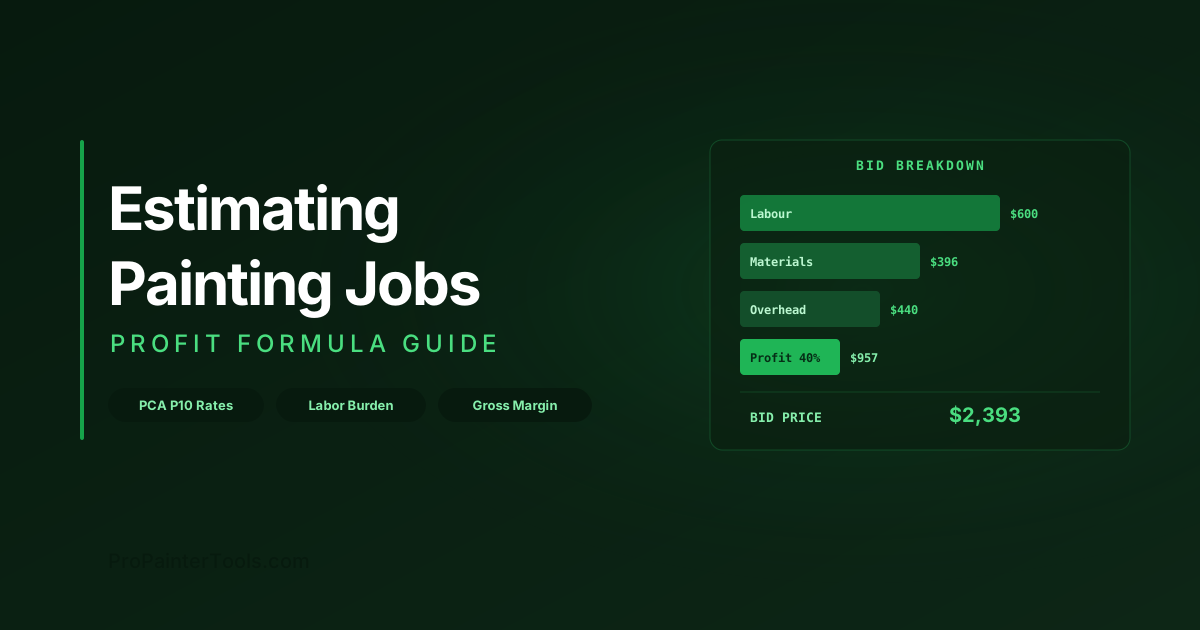
How to Estimate Painting Jobs for Profit: Formulas, Production Rates, and Bid Strategy
Most painting contractors undercharge — not because they underprice their labour, but because they undercount it. A room that takes four hours to paint takes six hours to prep, mask, move furniture, cut in, roll, clean up, and walk with the client. A contractor who estimates by gut feel or per-square-foot rules of thumb is building a business on a foundation that erodes with every job. This guide covers the systematic approach to painting estimates: production rates based on PCA P10, material takeoff, labor burden, overhead, and the gross margin targets that separate profitable contractors from ones who stay busy but never get ahead.
The Four Components of Every Painting Estimate
Every painting bid is the sum of four costs:
- Labour — hours × fully burdened hourly cost
- Materials — paint, primer, masking, sundries, equipment consumables
- Overhead — your share of fixed business costs allocated to this job
- Profit — the margin that funds growth, equipment replacement, and owner return
Missing or underestimating any one of these components produces a bid that loses money even when you win it. Estimating all four consistently, job after job, is what turns painting from a trade into a business.
Production Rates: What PCA P10 Tells You
The PCA P10 Production Rate Manual is the painting industry's standard reference for labour times. It publishes production rates by surface type, application method, and coating category — the result of decades of field data collection across commercial and residential painting operations.
Production rates are expressed in square feet per hour per painter for a given task.
Representative PCA P10 benchmarks:
| Task | Application Method | Production Rate |
|---|---|---|
| Interior walls — latex flat | Roller | 150 – 200 SF/hr |
| Interior walls — latex flat | Airless spray | 300 – 500 SF/hr |
| Interior trim — enamel | Brush | 60 – 100 LF/hr |
| Exterior siding — latex | Airless spray | 200 – 350 SF/hr |
| Exterior siding — latex | Brush/roller | 100 – 150 SF/hr |
| Ceiling — latex flat | Roller | 120 – 180 SF/hr |
| Cabinet doors — conversion varnish | HVLP spray | 8 – 14 doors/hr |
| Concrete floor — epoxy | Roller | 200 – 300 SF/hr |
| Surface prep — hand tool clean | Manual | 50 – 80 SF/hr |
| Masking — tape and paper | Manual | 40 – 80 LF/hr |
Use the conservative (lower) end of the range when estimating until your own historical data gives you a firmer baseline. Experienced crews on repeat work types can push toward the upper end. New crews, complex substrates, and difficult access always push toward the lower end.
Never use production rates without accounting for prep. Surface preparation is typically 25–40% of total labour hours on a painting job and is the most commonly underestimated line item. See our surface preparation standards guide for the full scope of prep work required before coating application.
Measuring for Your Estimate
Interior walls: Measure perimeter × ceiling height, then deduct 50% of door and window openings (the standard shortcut that accounts for the fact that cutting around openings is slower than rolling open wall, roughly offsetting the area deduction).
Ceilings: Length × width. Simple. Do not use wall square footage as a ceiling proxy.
Trim: Measure linear feet of baseboard, door casing, window casing, and crown moulding separately — they have different production rates.
Exterior: Break the elevation into rectangles and triangles. Include all fascia, trim, soffit, and gable ends as separate line items. Never lump exterior siding and trim together. For a full exterior repaint scope breakdown including substrate-specific prep hours and PCA P10 exterior production rates, see our exterior repaint estimating guide.
Cabinetry: Count door and drawer faces individually — production rates for cabinets are typically in doors per hour, not square feet.
Labor Cost: From Hours to Fully Burdened Cost
Raw hourly wages are not your labour cost. Your fully burdened labour rate includes everything you actually pay to put a worker on a job:
Labour burden components:
- Base wage
- Employer payroll taxes (FICA: 7.65% of wages)
- Workers' compensation insurance (varies by state and trade classification — painting is typically $8–$25 per $100 of payroll)
- General liability insurance (allocated per hour)
- Paid time off (vacation, sick days — divide annual PTO cost by productive hours)
- Health insurance contributions (if provided)
- Tool and equipment allowance
Labour burden calculation:
Burden Rate (%) = (Total Annual Burden Costs ÷ Annual Base Wages) × 100
For a painting trade in most US states, a realistic fully burdened rate runs 35–55% above base wage. A painter earning $22/hr base costs you $30–$34/hr fully burdened before a dollar of overhead or profit is applied.
Example:
- Base wage: $22.00/hr
- Payroll taxes (7.65%): $1.68/hr
- Workers' comp ($15/$100): $3.30/hr
- General liability + PTO + tools: $3.00/hr
- Fully burdened cost: $29.98/hr ≈ $30/hr
Material Takeoff
Paint quantity:
Gallons needed = (Surface area ÷ Theoretical coverage rate) × Number of coats × Waste factor
- Theoretical coverage rate: from the product data sheet (typically 300–400 SF/gallon for standard latex at recommended DFT)
- Waste factor: 1.10–1.15 for brush/roller; 1.20–1.30 for airless spray (accounting for overspray and material left in hose)
- Always round up to the nearest whole gallon or container size
Sundries: Budget 8–12% of paint cost for masking tape, plastic sheeting, roller covers, brush replacements, tray liners, and cleaning materials. On large commercial jobs, itemise these separately.
Review our professional coating guide for solids by volume and coverage rate data across epoxy, polyurethane, and architectural coating types — the right SBV figure in your takeoff is the difference between ordering enough material and making an emergency trip to the supplier mid-job.
Overhead Allocation
Overhead is every cost your business incurs that is not directly tied to a specific job: vehicle expenses, office rent, software subscriptions, insurance not allocated to labour, advertising, owner salary (if salaried), and equipment depreciation.
Calculate your overhead rate:
Annual overhead ($) ÷ Annual billable hours = Overhead cost per billable hour
Example:
- Annual overhead: $80,000
- Billable hours per year (2 painters × 1,800 hrs): 3,600 hrs
- Overhead rate: $22.22/hr per billable hour
This overhead rate is applied on top of direct labour and material costs in every estimate.
The Bid Formula
Bringing it together:
Job Cost = Labour hours × Burdened rate + Materials + Overhead allocation

Bid Price = Job Cost ÷ (1 − Target Gross Margin)
Example project — interior repaint, 1,200 SF walls, 2 coats:
| Line Item | Calculation | Cost |
|---|---|---|
| Labour: prep + mask (8 hrs) | 8 × $30 | $240 |
| Labour: paint (12 hrs at 100 SF/hr) | 12 × $30 | $360 |
| Paint: 8 gallons at $45 | — | $360 |
| Sundries (10% of paint) | — | $36 |
| Overhead (20 hrs × $22) | — | $440 |
| Total Job Cost | $1,436 | |
| Bid at 40% Gross Margin | $1,436 ÷ 0.60 | $2,393 |
Gross Margin vs Markup: Know the Difference
These terms are frequently confused and the confusion costs money.
Markup = Profit added on top of cost (e.g., 40% markup on $1,000 cost = $1,400 price)
Gross Margin = Profit as a percentage of the selling price (e.g., $400 profit on $1,400 price = 28.6% gross margin)
Applying a 40% markup does NOT give you 40% gross margin — it gives you 28.6%. To achieve 40% gross margin, you must divide cost by 0.60 (not multiply by 1.40).
Target gross margins for painting contractors:
- Residential repaint: 40–50% gross margin
- New construction: 30–40% gross margin (lower risk, higher volume)
- Commercial repaint: 35–45% gross margin
- Industrial / specialty coatings: 45–55% gross margin (higher skill, equipment, liability)
Frequently Asked Questions
How do I know if my production rates are accurate? Track actual hours against estimated hours on every job. After 20–30 jobs, your own historical data will be more accurate than any published rate for your specific market, crew, and work type. Build a simple spreadsheet that captures estimated vs actual hours by task — this is the single most valuable data asset in your business.
Should I include travel time in my estimate? Yes. Travel time is a real labour cost. Either build a standard travel allowance into your overhead calculation or add it as a direct line item on jobs beyond a certain radius. Ignoring travel time on distant jobs turns profitable work into breakeven work.
How do I compete against cheaper competitors without cutting margin? Compete on scope clarity, professional presentation, and documented processes — not price. A clearly itemised proposal that explains what is included (and what is not), references the surface preparation standard being used, and specifies the exact products being applied wins clients who are making an informed decision, not just picking the cheapest number.
What is a realistic net profit margin for a painting contractor? After overhead, a well-run residential painting company targets 10–15% net profit margin. Industrial and specialty contractors can reach 15–20%. If you are consistently below 8% net, the problem is almost always in underestimating labour hours or failing to recover overhead.
Production rate data referenced from PCA P10 Production Rate Manual. For current edition pricing and access, visit pcapainted.org.
Once your estimates are built, track actual vs estimated on every job — see our job costing and profitability guide for the report structure that identifies margin leaks. For new construction bidding where unit rates and GC subcontract terms differ from residential repaint, see our new construction painting guide. For managing the crew productivity that your estimates depend on, see our hiring and managing painting crews guide.
