Hiring and Managing Painting Crews — W2, 1099, Productivity, and Retention
19 April 2026 · ProPainterTools
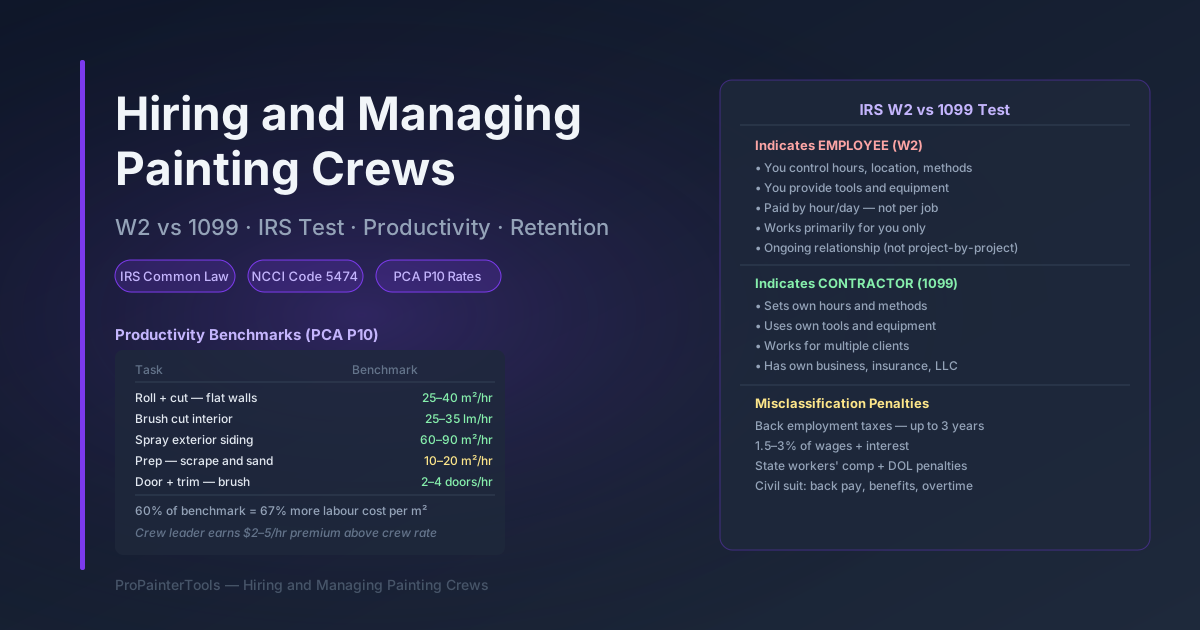
Hiring and Managing Painting Crews: W2, 1099, Productivity, and Retention
Transitioning from solo operator to managing employees is the hardest scaling step for most painting contractors. The financial, legal, and managerial complexity increases significantly — payroll taxes, workers' compensation, compliance, supervision, and productivity tracking all become new responsibilities. But it is also the step that unlocks volume, allows you to bid larger jobs, and removes the ceiling on revenue that is inherent in a one-person operation. This guide covers the legal classification of workers, the hiring and onboarding process, and how to manage crew productivity.
W2 Employee vs 1099 Subcontractor
This is the most legally consequential decision in hiring. Misclassifying an employee as an independent contractor is an IRS enforcement priority and carries substantial penalties.
The IRS Common Law Test
The IRS uses a set of factors to determine worker classification. No single factor is determinative — the totality of the relationship governs:
Behavioural control (indicating employee):
- You control when, where, and how the work is done
- You provide training on methods and procedures
- You set work hours and require the worker to be at specific locations
Financial control (indicating employee):
- You pay by the hour, day, or week rather than per job
- You provide tools and equipment
- The worker works primarily or exclusively for you
- The worker has no opportunity for profit or loss based on their business decisions
Type of relationship (indicating employee):
- There is a written employment contract
- You provide benefits (health insurance, vacation pay)
- The relationship is indefinite (not project-by-project)
- The work is a key part of your regular business
Indicators of genuine independent contractor:
- The worker sets their own hours and methods
- The worker uses their own tools and equipment
- The worker works for multiple clients
- The worker has their own business identity (LLC, insurance, business cards)
- The worker controls quality through their own standards, not your supervision
The practical test for painters: Most painters who work for you every day, use your sprayers, follow your schedule, and have no other clients are employees under the IRS test — regardless of what you call them. Using 1099 forms to avoid payroll taxes, workers' compensation premiums, and benefits for what are functionally employees is misclassification.
Penalties for Misclassification
The IRS can assess:
- Back employment taxes (employer's share of FICA) for up to three years
- Penalties of 1.5%–3% of wages for failure to withhold income tax
- Interest on unpaid amounts
State agencies (Department of Labor, unemployment insurance, workers' comp) can assess separate penalties for misclassification under state law, which in many states are significantly more aggressive than federal penalties.
The business also faces civil liability — misclassified workers can sue for back pay, benefits, and overtime.
When 1099 Subcontractors Are Legitimate
Genuine subcontractors — other licensed painting businesses or sole proprietors who work for multiple clients, carry their own insurance, and control their own methods — can legitimately be engaged as subcontractors. Require a Certificate of Insurance (including workers' compensation) from every subcontractor before they start work. If the sub does not carry workers' comp, your insurer may charge your policy for their payroll.
The Hiring Process
Job Posting and Sourcing
Effective channels for finding painters:
- Indeed and ZipRecruiter: Broad reach; write a clear job post with pay range
- Facebook local groups: High signal-to-noise in many markets for trade workers
- Referrals from current employees: Often the highest-quality source; consider an employee referral bonus ($200–$500 per hire who stays 90 days)
- Trade schools and apprenticeship programmes: Source of trained entry-level workers
- Competitor referrals: Painters who are laid off seasonally often circulate; treat them ethically and they remember
Pay transparency: Post your pay range. In many states it is legally required; everywhere, it filters out mis-matched candidates and reduces wasted time.
Skills Assessment
Before making an offer, assess practical skills:
- Ask to see previous work: Request photos on their phone. The quality of what they have documented tells you a lot about their standards.
- Tool knowledge: Ask them to describe their daily flush process for an airless sprayer, or how they select nap thickness for different surfaces. Experienced painters have specific, consistent answers.
- Trade vocabulary test: Ask about "cutting in," "back-rolling," "DFT," and "satin vs semi-gloss." Fluency in trade terminology is a reasonable proxy for experience.
- Reference check: Call previous employers. Ask specifically: "Would you re-hire this person?" Not "Was this person a good worker?" — the latter gets vague answers.
Onboarding Documentation
Once hired, complete these documents before the first day of work:
Federal requirements:
- Form I-9 (Employment Eligibility Verification): Verify identity and work authorisation documents within 3 business days of the first day of work. Retain for 3 years or 1 year after termination, whichever is later. E-Verify is federally required for government contractors and some state programmes.
- Form W-4 (Employee's Withholding Certificate): Required for federal income tax withholding. New form is required when the employee's situation changes.
State requirements:
- State new hire reporting (most states require employers to report new hires to a central registry within 20 days)
- State income tax withholding form (varies by state)
Company onboarding:
- Offer letter with pay rate, classification (full-time / part-time), and schedule
- Employee handbook acknowledgement (if you have one)
- Safety orientation — this should be documented. Cover: respiratory protection requirements, fall protection requirements, PPE expectations, and emergency procedures. A signed safety orientation form protects you.
- Vehicle use policy (if company vehicles are used)
Crew Structure and the Crew Leader Role
A productive painting crew is not a flat group — it has a defined crew leader who is responsible for daily productivity, quality, and communication with the office.
Crew leader responsibilities:
- Opens the job site and confirms materials are on hand before the crew arrives
- Sets the daily task sequence and assigns workers to tasks
- Communicates production progress to the owner or project manager mid-day
- Completes the end-of-day timesheet and materials tally
- Manages punch list items and client-facing communication on site
- Responsible for tool security and cleanliness at job close
Crew leader compensation: A crew leader earns more than a painter — typically $2–$5/hour above the crew rate, depending on the size of the crew and level of autonomy. The premium is easily justified by the management efficiency it creates.
Optimal crew size: For most residential painting, a crew of 2–3 (one crew leader plus one or two painters) is the production-efficient unit. Larger crews on a single job produce diminishing returns — access bottlenecks, coordination overhead, and material logistics begin to offset the additional labour.
Productivity Tracking
Track productivity at the task level: hours per unit of work completed.
Key metrics for painters:
| Task | Metric | PCA P10 Benchmark |
|---|---|---|
| Roll and cut — flat walls | m² per hour | 25–40 m²/hr (production conditions) |
| Brush cut interior | linear metres per hour | 25–35 lm/hr |
| Spray exterior siding | m² per hour | 60–90 m²/hr (airless) |
| Prep — scrape and sand | m² per hour | 10–20 m²/hr (varies by condition) |
| Door and trim — brush | units per hour | 2–4 doors/hr |
Compare your crew's logged hours against these benchmarks monthly. A crew running at 60% of benchmark productivity costs you 67% more labour per unit of output than a benchmark crew. Identify whether the shortfall is individual (one slow worker), systematic (incorrect task assignment or tools), or scope-related (more substrate condition than estimated).
Retention
The cost of replacing a trained painter — recruiting, onboarding, and lost productivity during the learning period — is typically 20–40% of their annual salary. Retention is an investment that pays.
Retention levers:
- Pay predictability: Know-it-in-advance earnings matter more to most workers than occasional bonuses. Annual raises on a known schedule beat unpredictable one-offs.
- Equipment quality: Workers who are proud of their tools and equipment take more ownership of outcomes. Cheap consumables signal that you do not value their work quality.
- Seasonal stability: Year-round work or guaranteed winter hours (interior projects, touch-up, prep shop work) is a powerful retention tool in seasonal markets.
- Advancement path: Define what a painter needs to demonstrate to become a crew leader. A visible progression increases tenure.
- Respect and communication: Tell crews what jobs are coming, what is expected, and how the business is doing. Workers who understand the business context perform differently than those who just show up and paint.
For payroll, insurance, and classification-related costs that feed into your overhead rate, see our insurance guide. For how crew productivity feeds into your job estimates, see our estimating guide.
ProPainterTools helps you track actual hours per crew and task against estimated hours — the foundation of crew productivity measurement.
Frequently Asked Questions
Can I pay painters in cash to avoid payroll? No. Paying wages in cash does not exempt you from payroll tax obligations. You are still required to withhold federal and state income tax, Social Security, and Medicare — regardless of payment method. Paying "off the books" is tax evasion.
What is the minimum wage for painters? Federal minimum wage is $7.25/hour, but many states have higher minimums, and some cities have local minimums above the state level. Prevailing wage requirements apply to public works projects — painting on government-funded jobs may require paying the locally determined prevailing wage for painters, which is significantly higher than minimum wage. Check the Davis-Bacon Act requirements for any federally funded project.
How do I handle a worker who is slow but not bad enough to fire? Document the performance issue with specific examples (hours logged vs expected on specific tasks), have a direct conversation with clear expectations and a timeframe, and document that conversation. If performance does not improve within the agreed timeframe, you have a documented basis for separation. Without documentation, a termination becomes a legal exposure.
Do I need a written employment contract for painters? Not legally required for at-will employment in most states, but an offer letter setting out pay, schedule, and classification is good practice. For crew leaders with more authority and higher pay, a short written agreement clarifying duties, pay structure, and confidentiality is worthwhile.
