Painting Business Insurance Guide — Liability, Workers' Comp, and Bonds
18 April 2026 · ProPainterTools
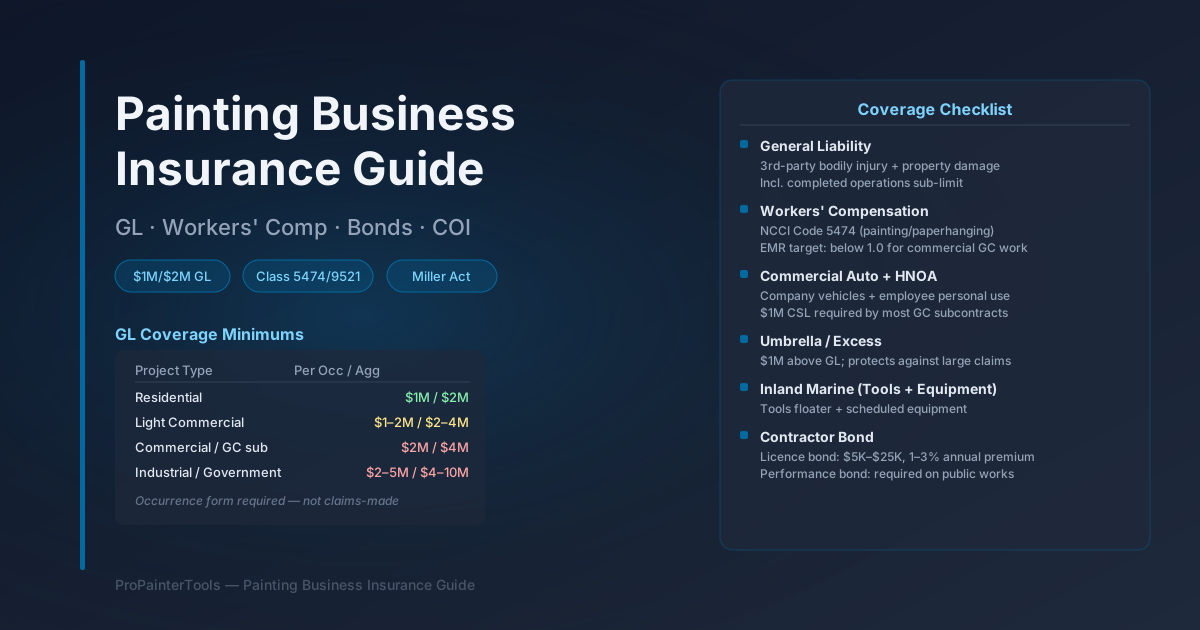
Painting Business Insurance Guide: Liability, Workers' Comp, and Bonds
Insurance is the operating cost most painting contractors underestimate until they need it. A single uninsured incident — a fire started by a dropped heat gun, a worker fall, a vehicle accident with equipment on board — can eliminate years of business profit or end the business entirely. Beyond protecting the business, adequate insurance is a commercial requirement: general contractors will not allow uninsured subcontractors on their sites, and some residential clients now request certificates before work begins. This guide covers the coverage types relevant to painting contractors, the minimum limits that apply in most commercial contexts, and the cost factors you can control.
General Liability Insurance
General liability (GL) insurance covers third-party bodily injury and property damage caused by your business operations. For a painting contractor, this means: a client trips over your drop cloth and breaks a wrist; overspray damages a client's vehicle; a fire starts from improper solvent storage; or paint fumes damage adjacent property.
Coverage components:
- Occurrence limit: The maximum the insurer pays for a single claim. Standard minimum is $1,000,000 per occurrence.
- Aggregate limit: The maximum paid across all claims in the policy year. Standard minimum is $2,000,000 aggregate.
- Products and completed operations: Covers claims arising after the work is finished — a coating failure that causes damage a year later, for example. This is often a separate sub-limit and must be confirmed as part of the policy.
Commercial GL minimum limits:
| Project Type | Recommended Per Occurrence | Aggregate |
|---|---|---|
| Residential painting | $1M | $2M |
| Light commercial | $1M–$2M | $2M–$4M |
| Commercial / GC subcontract | $2M | $4M |
| Industrial / government | $2M–$5M | $4M–$10M |
General contractors typically require subcontractors to carry at least $1M/$2M for residential work and $2M/$4M for commercial. The GC's contract will specify the required limit and additional insured endorsement requirements — read the subcontract before agreeing to work for a new GC.
Additional insured endorsement: Many GC contracts require you to name the GC (and sometimes the property owner) as an additional insured on your GL policy. This extends your GL coverage to protect them from claims arising from your work. Most insurers provide this endorsement for a modest additional cost.
Workers' Compensation Insurance
Workers' compensation covers your employees for work-related injuries and illnesses — medical treatment, lost wages, and rehabilitation. In most states, workers' compensation is legally mandatory for any employer with one or more employees. Sole proprietors with no employees may be exempt, but exemption varies by state and often has conditions.
Why it matters for painters: Painting is a physically demanding trade with meaningful injury exposure — falls from ladders and scaffolding, chemical burns from solvents and strippers, respiratory injuries, and musculoskeletal injuries from repetitive overhead work. Workers' compensation claims in painting are common.
Painting Class Codes
Workers' compensation premium is calculated as a rate per $100 of payroll, multiplied by the class code rate that applies to the work performed. The class code determines the rate — painting has two primary codes:
- NCCI Class Code 5474 — Painting and Paperhanging: The standard code for residential and commercial interior and exterior painting contractors. Applies to brush, roller, and spray application of paints, varnishes, and similar finishes.
- NCCI Class Code 9521 — Building Painting — Interior: Used in some states for interior-only painting. Typically carries a lower rate than 5474.
Classification matters significantly. A contractor misclassified under a higher-risk class code (such as a roofing or masonry code) pays more than necessary. A contractor improperly using a lower-risk code to reduce premiums faces premium audit correction and potential fraud penalties.
Experience modification rate (EMR): After three years of workers' compensation history, your insurer calculates an Experience Modification Rate (EMR) that adjusts your premium up or down based on your claims history versus the industry average. An EMR of 1.0 is average; 0.85 means 15% below average (premium credit); 1.25 means 25% above average (premium surcharge). Commercial GCs often require subcontractors to have an EMR below 1.0 or 1.1.
Reducing workers' comp cost:
- Document a formal safety programme (written safety policy, toolbox talks, PPE requirements)
- Report injuries promptly — delayed reporting increases claim cost
- Manage return-to-work — light duty positions reduce lost-time claims
- Contest claims that are not work-related
Commercial Auto Insurance
If your business operates vehicles — trucks, vans, trailers — used for business purposes, personal auto insurance does not cover accidents during business use. Commercial auto insurance covers vehicles used for business.
Key coverage types:
- Business auto: Covers company-owned vehicles
- Hired and non-owned auto (HNOA): Covers employees using personal vehicles for business (driving to a supply house, using a personal truck on a job) and vehicles you rent. HNOA is inexpensive and important — employee personal auto policies typically exclude business use.
GC requirements: Many commercial GC subcontracts require a minimum of $1M combined single limit on business auto. Confirm your policy limits meet subcontract requirements.
Umbrella / Excess Liability
An umbrella policy sits above your GL and auto liability limits, providing additional coverage when the underlying policy limit is exhausted. For painting contractors doing commercial work, a $1M umbrella above $2M GL is relatively inexpensive and significantly expands your coverage for large claims.
When umbrella matters: A single serious injury on your job site can generate claims exceeding $2M — particularly for spinal injuries, traumatic brain injuries, or fatalities. Without an umbrella, your business assets and future earnings are at risk once the GL limit is exhausted.
Inland Marine (Equipment) Insurance
Inland marine insurance covers tools, equipment, and materials in transit and on job sites. Standard property insurance covers items at a fixed location (your office or shop); inland marine covers mobile property.
For painting contractors: Airless sprayers, scaffolding, lifts, generators, and tool sets are expensive. A $30,000 equipment loss is a significant business event — more so if a single job wipes out an entire crew's equipment. Inland marine coverage with a per-item and aggregate limit protects against theft, fire, vandalism, and accidental damage.
Tools floater vs scheduled equipment: A tools floater covers small tools under a blanket limit (e.g., $10,000 for all hand tools and equipment under $1,500 per item). Scheduled equipment lists specific items (airless sprayer, generator) by serial number for higher individual item limits. Use a combination for most painting operations.
Contractor Bonds
A bond is not insurance — it is a financial guarantee to a client that you will complete the contracted work and comply with applicable laws. Two types are relevant to painting contractors:
Licence bond (surety bond): Many states require a surety bond as a condition of contractor licensing. The bond amount (typically $5,000–$25,000) guarantees that the contractor will comply with licensing requirements. The premium is typically 1–3% of the bond amount annually.
Performance and payment bond: Required on public works projects above a threshold (typically $100,000–$500,000 for public projects, per the Miller Act for federal contracts). The bond guarantees the contractor will complete the project and pay subcontractors and suppliers. Premium is typically 1–3% of the contract value. Required for public school, government, and municipal painting contracts above the threshold.
Certificate of Insurance
A Certificate of Insurance (COI) is a document your insurer or broker produces that summarises your active coverage — policy numbers, types, limits, and effective dates. Clients, GCs, and property owners request COIs before allowing work to start.
What a COI includes:
- Insurer name and NAIC number
- Policy types and numbers (GL, auto, workers' comp, umbrella)
- Limits per coverage
- Policy effective and expiry dates
- Additional insured endorsements (if applicable)
- Certificate holder (the party requesting it)
Response time: Request COIs from your broker in advance of project start. Most brokers provide COIs within 24–48 hours. Having a GC's project held up because you cannot produce a COI is a preventable credibility issue.
For contract language governing payment, warranty, and liability, see our painting contract templates guide. For licensing requirements that affect your insurability and bondability, see our painting contractor licensing guide.
ProPainterTools helps you store certificate of insurance details per client and GC relationship, track renewal dates, and ensure you never approach an insurance expiry without notice.
Frequently Asked Questions
Is general liability insurance required by law? Not by most state laws — but it is effectively required commercially. Most GCs require proof of GL before allowing subcontractors on their sites. Without GL, a single property damage claim can exceed your business assets.
What is the difference between an occurrence policy and a claims-made policy? An occurrence policy covers incidents that happen during the policy period, regardless of when the claim is filed. A claims-made policy only covers claims filed while the policy is active. Most contractors should carry occurrence-form GL — claims-made policies require a separate "tail" policy after cancellation to cover claims filed after the policy ends.
How does an insurance audit work for workers' comp? At the end of the policy year, the insurer audits your actual payroll records to reconcile against the estimated payroll used to set premiums. If your actual payroll exceeded the estimate, you pay additional premium. If it was lower, you receive a credit. Keep accurate payroll records and separate them by class code (painting vs. supervisory vs. clerical).
Can I add subcontractors to my workers' comp policy? No — your workers' comp covers your employees only. Subcontractors who are truly independent (with their own workers' comp) are excluded. However, if a subcontractor cannot prove their own workers' comp coverage, most insurers will charge your policy for their payroll — verify every subcontractor's COI before they start work.
