Painting Contractor Licensing — State Licences, EPA RRP, and OSHA Credentials
21 April 2026 · ProPainterTools
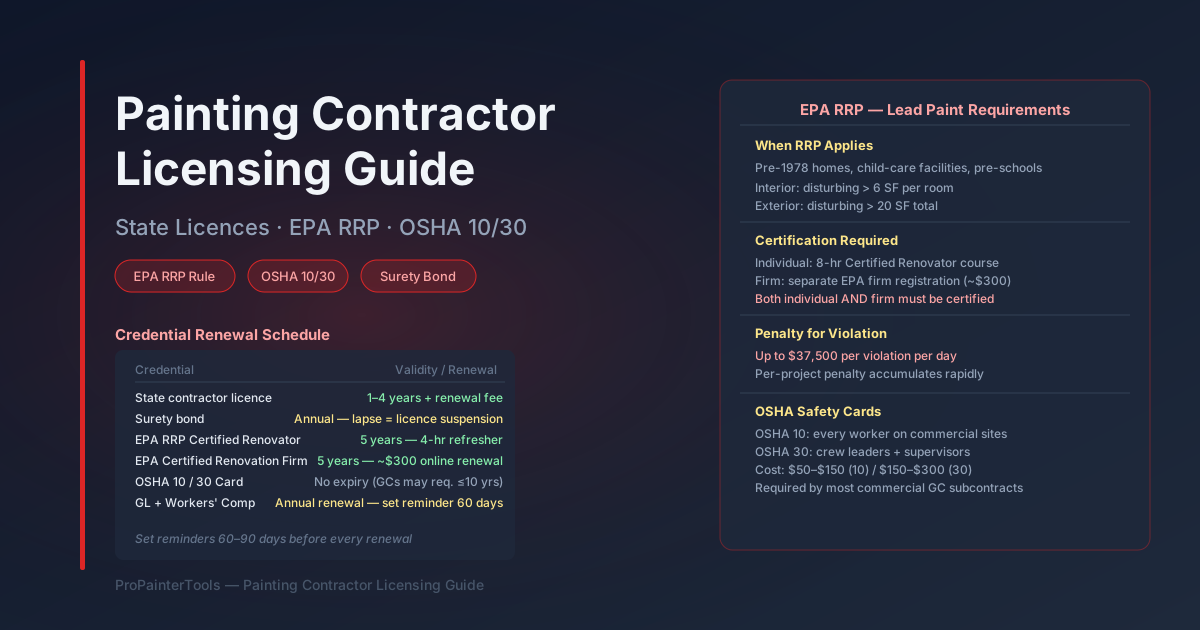
Painting Contractor Licensing: State Licences, EPA RRP, and OSHA Credentials
Licensing requirements for painting contractors vary significantly by state — some states require a specific painting or specialty contractor licence; others license all contractors under a general contractor category; several large states (Texas, New York) have minimal state-level contractor licensing and rely on county or municipal requirements. Beyond state licensing, two federal credentialing programmes are mandatory in specific circumstances: EPA Renovation, Repair, and Painting (RRP) certification for work on pre-1978 homes, and OSHA safety training cards that commercial GCs and public works programmes routinely require. This guide covers what is required, how to obtain it, and how to maintain it.
State Contractor Licence Requirements
How States Categorise Painting Licences
States that license painting contractors do so under one of three models:
Painting-specific licence: The state has a dedicated painting or specialty contractor licence category. Examples: California (C-33 Painting and Decorating), Florida (Painting Specialty Contractor), Louisiana (Painting Contractor). These licences require examination on trade knowledge, business law, and safety.
General or specialty contractor licence: The state licences all trade contractors under a single specialty contractor category or requires a general contractor licence for all work above a threshold value. Examples: Alabama, Georgia, Virginia. Trade-specific knowledge is tested within a broader licence structure.
Registration only (no state trade exam): Some states require contractors to register with a state agency (typically for consumer protection purposes — background check, insurance verification) but do not require passing a trade examination. Examples: Texas (Home Improvement Registration in some counties), Illinois (varies by municipality).
No state licence requirement: A small number of states have no state-level contractor licensing for most trades. Work may still be regulated at city or county level.
What Licence Applications Typically Require
Regardless of state, most licence applications require some combination of:
- Proof of experience: Typically 2–4 years in the trade, documented by prior employer letters, tax records showing trade income, or affidavits from clients
- Trade examination: Closed-book exam covering paint chemistry, surface preparation, safety, estimating, or business management — depending on the state
- Business and law examination: Separate exam on contracts, payroll, insurance, and business operation
- Proof of insurance: Certificate of general liability insurance and (if you have employees) workers' compensation at the state's minimum required limits
- Surety bond: A licence bond guaranteeing compliance with licensing requirements — typically $5,000–$25,000; annual premium is 1–3% of the bond amount
- Application fee: Varies from $50–$500 depending on the state and licence class
Reciprocity Between States
Some states have reciprocity agreements that allow a licensed contractor from one state to obtain a licence in another state without re-examination, based on holding an equivalent active licence. Reciprocity is state-specific and often limited to states with comparable examination standards.
Before applying for reciprocity, verify: (1) whether the states have a current reciprocity agreement, (2) whether your licence category qualifies (painting contractors may be excluded from reciprocity agreements that apply to general contractors), and (3) whether insurance and bond requirements in the new state differ from your current state.
Practical approach: Check the licensing board website of the state you want to work in. Search for "reciprocity" or "endorsement" — these terms are used interchangeably across states. Contact the board directly to confirm current reciprocity status; agreements change.
Unlicensed Contracting Penalties
Working without a required licence is a misdemeanour or civil violation in most states, with penalties including:
- Fines of $1,000–$10,000 per violation
- Stop-work orders
- Prohibition from filing mechanic's liens for that project
- In some states: being required to refund all payments received for unlicensed work (consumer restitution)
- Criminal prosecution in states where repeated violations are elevated to felonies
EPA RRP Certification
The EPA Renovation, Repair, and Painting (RRP) Rule applies to work disturbing lead-based paint in homes, child care facilities, and pre-schools built before 1978. If you sand, scrape, cut, or disturb more than six square feet of painted surface per room (interior) or more than 20 square feet (exterior) in a pre-1978 residential building or child care facility, RRP applies.
Why this matters for painters: Exterior repaints and interior repaint projects on older homes routinely trigger RRP thresholds during surface preparation.
RRP Certification Structure
RRP certification exists at two levels:
Certified Renovator (individual): An individual who has completed EPA-accredited RRP training (typically an 8-hour initial course). Certified Renovators must be present when lead-safe work practices are being performed and are responsible for training other workers, setting up containment, and conducting post-work cleaning verification.
Certified Renovation Firm (company): The business entity performing the work must be separately certified as a Renovation Firm with the EPA. Firm certification is obtained by applying to the EPA (or the state, in EPA-authorised states) and paying the registration fee. A firm can employ multiple Certified Renovators.
Critical point: Both the individual and the firm must be certified. A Certified Renovator working for an uncertified firm is not compliant. A certified firm that sends uncertified workers is not compliant.
Lead-Safe Work Practices
RRP-certified renovators must implement lead-safe work practices:
- Containment: Plastic sheeting to contain dust and debris; close windows and doors in work areas
- Minimise dust: Wet scraping, wet sanding, or HEPA-vacuum attachment on power tools
- No prohibited practices: No open-flame burning/torching, no power sanding/grinding/blasting without HEPA exhaust control, no dry scraping except within 1 inch of glazing
- Cleaning verification: After work, clean the area and perform a cleaning verification test (cardboard wipe on hard floors and window sills)
- Record-keeping: Retain records for three years: work order, notification to owner, cleaning verification results
RRP Penalties
EPA enforcement of RRP violations is active. Civil penalties up to $37,500 per violation per day. For a firm performing multiple uncertified projects, penalty accumulation is rapid. State-level enforcement in EPA-authorised states is often more aggressive than federal.
Obtaining RRP Certification
- Find an EPA-accredited training provider (search the EPA's training provider database at epa.gov/lead)
- Complete the 8-hour Certified Renovator course (available in-person and online)
- Receive your Certified Renovator certificate
- Register your firm with the EPA (or your state's EPA-authorised programme) — application at epa.gov/lead, approximately $300 every five years
- Renew the Certified Renovator credential every five years (4-hour refresher course)
OSHA Safety Training Cards
OSHA 10-hour and 30-hour construction safety training cards are increasingly required by commercial GCs and public works programmes as a condition of allowing workers on site. While not universally legally mandatory for painting contractors (OSHA standards apply to all employers regardless of card status), the card is a practical commercial requirement for commercial and institutional work.
OSHA 10 — Construction (for Workers)
A 10-hour course covering the most critical OSHA construction standards: fall protection, scaffolding, PPE, hazard communication, struck-by, electrical, and caught-in. Completion results in an OSHA 10-Hour Card.
Who should have it: Every worker on commercial job sites where GCs require cards. For a residential painter moving into commercial work, OSHA 10 is the entry credential.
OSHA 30 — Construction (for Supervisors)
A 30-hour course covering all OSHA 10 content in greater depth plus additional topics: safety programme management, training requirements, record-keeping (OSHA 300 log), and employer responsibilities. Completion results in an OSHA 30-Hour Card.
Who should have it: Crew leaders, foremen, and supervisors on commercial job sites. Many GC subcontracts require at least one OSHA 30 card holder present on each crew.
Obtaining OSHA Cards
OSHA 10 and 30 are delivered through OSHA-authorised training providers. Courses are available in-person and through OSHA-authorised online providers. Cards are issued by OSHA and arrive by post; the provider issues a certificate of completion immediately.
Cost: OSHA 10 is typically $50–$150; OSHA 30 is $150–$300. Cards do not expire, but some GCs and municipalities require cards issued within 5–10 years.
Maintaining and Renewing Credentials
| Credential | Initial Validity | Renewal |
|---|---|---|
| State contractor licence | Varies (1–4 years) | Renewal fee + continuing education in some states |
| Surety bond | Annual | Annual premium payment; policy cancels if unpaid |
| General liability insurance | Annual | Annual renewal with insurer |
| Workers' compensation | Annual | Annual renewal; payroll audit at year-end |
| EPA RRP Certified Renovator | 5 years | 4-hour refresher course |
| EPA Certified Renovation Firm | 5 years | Online renewal application + fee |
| OSHA 10 / 30 Card | No expiry | Some GCs require within 5–10 years; re-take if required |
Credential tracking: Set calendar reminders 60–90 days before any renewal deadline. A lapsed contractor licence can trigger stop-work orders on active jobs. A lapsed surety bond results in automatic licence suspension in most states. A lapsed COI (Certificate of Insurance) prevents you from starting new commercial jobs and can breach subcontracts already in progress.
For the insurance coverage types that interact with your licence and bond requirements, see our painting business insurance guide. For the contract structure that your licensing status affects, see our painting contract templates guide.
ProPainterTools helps you store your licence numbers, bond details, and insurance renewal dates in one place — with visibility into what expires when, so credentials are never the reason you miss a project.
Frequently Asked Questions
Do I need a licence to paint in every state I work in? If you are based in one state and perform incidental work in a neighbouring state, the neighbouring state's licensing requirements apply. Most states do not have an exemption for out-of-state contractors. Check the licensing board website of each state where you intend to work regularly.
Does EPA RRP apply if the homeowner says the paint is not lead-based? The rule is triggered by the age of the building (pre-1978) and the scope of work, not by the homeowner's belief about lead content. To establish that lead is absent, a lead test kit or lead inspector/risk assessor (certified professional) must confirm no lead above threshold levels in the specific areas being disturbed. Without confirmed testing results, assume lead and apply lead-safe work practices.
Can a sole proprietor with no employees skip workers' compensation? In most states, a sole proprietor or single-member LLC with no employees can file for an exemption from workers' compensation requirements. If you are working as a subcontractor, the GC's insurer may charge the GC's workers' comp policy for your payroll unless you provide a valid workers' comp exemption certificate. Obtain the exemption certificate from your state's workers' comp board if you are exempt.
How long does it take to get a state contractor licence? The examination and application process typically takes 2–6 months from start to issued licence, depending on exam scheduling availability and the state's processing time. Schedule the exam early if you have a project start date in mind — the licence is not issued until you pass the exam.
What happens if my surety bond is cancelled? Your state licensing board is notified of bond cancellation (most bonds include a 30-day notice provision to the licensing board). The board will typically suspend your licence automatically or require you to provide a replacement bond within a short window. Work performed after bond cancellation without reinstatement is unlicensed contracting.
