Invoicing and Collections for Painting Contractors — Terms, Overdue, and Liens
21 April 2026 · ProPainterTools
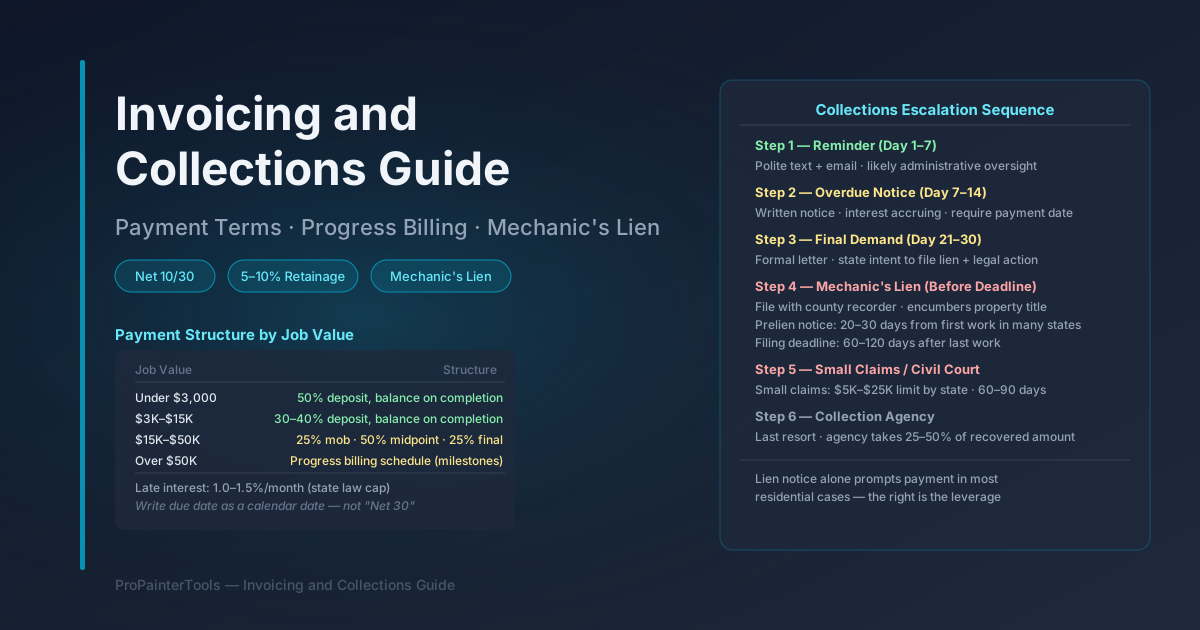
Invoicing and Collections for Painting Contractors: Terms, Overdue, and Liens
Cash flow is the most common cause of failure for small painting contractors — not lack of revenue, but revenue arriving too slowly or not at all. A contractor who finishes a $15,000 job and waits 90 days to be paid has effectively lent that money to the client interest-free while still paying wages, materials, and overhead. A contractor who never collects has done the work for nothing. This guide covers invoice structure, payment terms, progress billing for larger jobs, and the escalation sequence when invoices go unpaid — including the mechanic's lien process as a last resort.
Invoice Structure
A professional invoice is a legal document — it must be complete and specific enough to enforce in a small claims court or support a lien claim if necessary.
Required fields on every invoice:
- Your business name, address, and contact information
- Invoice number — sequential, for your records and dispute resolution
- Invoice date and payment due date (not just "Net 30" — use the actual calendar date)
- Client name and billing address (must match the contract)
- Job site address (may differ from billing address)
- Contract reference — cite your contract number or agreement date
- Line items: Each scope element listed separately with quantity, unit, unit price, and extended amount
- Subtotal, tax (if applicable), total due
- Payment instructions: Bank transfer details, cheque payable to name, or payment link
Line items vs lump sum: Lump sum invoices ("Painting services — $8,500") are legally enforceable but create disputes. Line-item invoices ("Interior walls — 320m² × $18.50/m² = $5,920; Interior trim — 180 lm × $8.00/lm = $1,440; ...") are harder to dispute because the client can see exactly what they are paying for. Line-item invoicing also supports change order management — additions are clearly additional, not buried.
Payment Terms
Standard residential terms: Payment in full upon completion of work. For jobs under $5,000, a single invoice at job completion is standard and appropriate.
Recommended terms by job size:
| Job Value | Recommended Structure |
|---|---|
| Under $3,000 | 50% deposit, balance on completion |
| $3,000–$15,000 | 30–40% deposit, balance on completion |
| $15,000–$50,000 | 25% mobilisation, 50% at midpoint milestone, 25% on completion |
| Over $50,000 | Progress billing schedule tied to milestones or percentage complete |
Deposit collection: Collect deposits by bank transfer where possible — cheques can be stopped. For new residential clients, a cleared deposit before mobilising is a reasonable protection against non-payment risk.
Payment due date language: Write the due date as a calendar date on the invoice, not just "Net 10" or "Net 30." Ambiguity about when the clock starts (invoice date vs receipt vs "upon satisfactory completion") generates disputes. Write: "Payment due by date."
Late payment interest: Include interest on overdue balances in your standard terms. State usury laws cap interest rates — most states permit 1.0–1.5% per month (12–18% per annum) on commercial invoices. For consumer (residential) invoices, the limits are often lower — check your state's consumer protection statute. State the rate explicitly: "Unpaid balances accrue interest at 1.5% per month (18% per annum) after the due date."
Progress Billing
For jobs over $15,000 or extending more than two to three weeks, progress billing (invoicing at milestones or percentage of completion) is standard practice and should be established in the contract before work begins.
Milestone-based billing example:
| Milestone | Invoice Amount |
|---|---|
| Contract signed and deposit received | 25% |
| Substrate preparation and priming complete | 30% |
| First finish coat complete | 30% |
| Punch list complete and final walkthrough | 15% |
Percentage-of-completion billing: Alternative to milestones — invoice monthly for the percentage of work completed. Requires an agreed method for determining percentage complete (typically crew leader's assessment or owner inspection). Requires a schedule of values (the contract price broken down by scope section) agreed in advance.
Retainage: On commercial and GC subcontract work, the GC typically withholds a percentage of each progress billing (commonly 5–10%) until final completion. Retainage is held as security against punch list work and warranty claims. The retainage release schedule should be written into the subcontract — confirm the conditions and timeline for release before signing.
Cash flow on retainage: For a $100,000 job with 10% retainage, $10,000 is withheld until final. Budget accordingly — retainage is real money owed but not yet in hand. Factor retainage timing into your job cash flow projections.
The Collections Escalation Sequence
When an invoice goes unpaid, escalate through a defined sequence. The goal at each step is payment; the documentation at each step protects you if you reach legal action.
Step 1 — Reminder (Day 1–7 Overdue)
A polite reminder: "Our records show invoice #number for $amount was due on date and remains outstanding. Please confirm payment details or let us know if there is an issue."
Send by text (for residential clients) and email (for commercial). Keep the tone neutral — the majority of late payments are administrative oversights, not bad faith.
Step 2 — Formal Overdue Notice (Day 7–14 Overdue)
A written notice (email or letter) stating the overdue amount, the original due date, the interest that has begun accruing, and the date by which you require payment or a payment plan in writing. Reference your contract and payment terms. Keep the tone firm but professional.
Step 3 — Final Demand (Day 21–30 Overdue)
A formal demand letter (email with delivery confirmation, or posted with tracking) stating: the overdue amount plus accrued interest; that you will pursue available legal remedies including mechanic's lien filing and small claims action if payment is not received within specific date — typically 7–10 days; and a request for a payment plan if full payment is not possible.
Step 4 — Mechanic's Lien (Before Deadline — See Below)
If the client owns real property (residential or commercial), file a mechanic's lien. A lien encumbers the property title, preventing sale or refinancing until the lien is resolved. This is the most powerful collection tool available to contractors.
Step 5 — Small Claims or Civil Court
For amounts within your state's small claims limit (typically $5,000–$25,000), small claims court is accessible without an attorney, inexpensive to file, and typically results in judgment within 60–90 days. Amounts above the small claims threshold require civil court and typically require an attorney.
Step 6 — Collection Agency / Debt Sale
A last resort after legal options are exhausted or the judgment is uncollectable. Collection agencies typically take 25–50% of recovered amounts. The residual recovery is often better than continued pursuit of an empty judgment.
Mechanic's Lien Process
A mechanic's lien (also called a construction lien or materialman's lien) is a legal claim against real property for unpaid labour or materials used to improve that property. Every US state has mechanic's lien laws; the procedures and deadlines vary by state.
The key dates:
- Preliminary notice deadline: Many states require you to serve a preliminary notice (also called a prelien notice or notice to owner) within a set number of days of starting work — typically 20–30 days. In states that require it, failure to serve the preliminary notice forfeits your lien rights. Check your state's requirement before mobilising on any job.
- Lien filing deadline: After the job is completed or you last provided labour/materials, you have a deadline to file the lien with the county recorder — typically 60–120 days depending on the state and project type. Missing this deadline permanently forfeits your lien rights on that job.
- Enforcement deadline: After filing, you must file a lawsuit to enforce the lien within a further period — typically 1–2 years. An unfiled lien that is not enforced expires.
What to include in a lien claim:
- Your business name and address
- Property owner name
- Property legal description and address
- Amount owed
- Brief description of the work performed
- First and last date of work
After filing: Notify the property owner that you have filed a lien. Most residential owners are motivated to resolve the lien quickly because it clouds the title. Commercial owners may negotiate; some may require you to enforce before they take it seriously.
Attorney assistance: Mechanic's lien procedures are technical and state-specific. For claims above $5,000, the cost of a construction attorney to ensure the lien is filed correctly is worthwhile. An improperly filed lien can be challenged and voided.
Accounting Software Integration
Issuing professional invoices and tracking payment status manually becomes unmanageable beyond 10–15 active clients. Accounting software that integrates with your banking automates reconciliation and provides real-time visibility into outstanding receivables.
Options for painting contractors:
- QuickBooks Online: Market standard; integrates with most estimating and job management platforms. Invoice templates, automatic reminders, and ACH payment collection are built in.
- FreshBooks: Simpler than QuickBooks; strong invoice and payment collection features with automated late payment reminders.
- Wave: Free for invoicing and accounting; suitable for solo operators and very small operations.
- Jobber: Field service management platform that includes invoicing, payment collection, and client communication integrated with scheduling and job tracking.
Minimum capability required: Whatever tool you use, it should (1) issue professional invoices with your logo and line items, (2) track payment status per invoice, (3) send automatic payment reminders, and (4) record payments against invoices for reconciliation.
For the contract language that governs your payment terms and dispute resolution, see our painting contract templates guide. For the broader financial management of your business — overhead tracking, markup, and profit — see our job costing guide.
ProPainterTools generates professional invoices directly from accepted quotes — line-item breakdown, your business details, and payment terms included automatically — eliminating the manual step between completed job and sent invoice.
Frequently Asked Questions
Can I charge interest on overdue invoices without putting it in the contract? Most states permit interest on overdue commercial invoices under their prompt payment statutes even without a contract provision, but the rate is limited. To charge the maximum permitted rate and to apply it to residential clients, include the rate explicitly in your contract and on your invoices.
What is the fastest way to collect a residential overdue invoice? A mechanic's lien notice (even before filing) prompts payment in most cases. A residential client who is told that their property title will be encumbered within 7 days if payment is not received typically pays quickly. The lien right itself is the leverage — you do not always need to file.
Can I withhold final coat or punch list work until I receive payment for earlier progress invoices? Yes, generally — you have the right to suspend work for non-payment of undisputed amounts, but check your contract language and state law. You must typically give written notice of intent to suspend before stopping work. Suspending work on a disputed invoice can create a contract breach claim against you if the dispute is later resolved in the client's favour.
How do I handle a client who pays a cheque that bounces? Notify the client immediately and demand payment by bank transfer or cash equivalent within a defined period (24–48 hours). Most states have criminal bad cheque statutes; sending a statutory notice entitles you to additional damages (typically 2–3× the cheque amount up to a limit) if the cheque is not made good. File a police report for intentional bad cheques.
At what point should I involve a collection attorney? When you have a judgment or a filed lien and the client has identifiable assets (property, bank accounts, business) that a judgment can reach, a collections attorney can execute on the judgment — garnishing bank accounts or placing levies on property. Attorney-assisted collection is cost-effective above approximately $5,000 where the debtor has attachable assets.
