Surface Preparation Tools Guide — Angle Grinders, Sanders, and Power Tools for Painters
10 April 2026 · ProPainterTools
Surface Preparation Tools Guide: Angle Grinders, Sanders, and Power Tools for Painters
Surface preparation is the most labour-intensive part of most coating projects, and the right tool for the task makes a significant difference in speed, surface quality, and the SP grade achievable. Using a disc sander where a needle scaler is needed, or an orbital sander where a belt sander is required, wastes time and produces an inferior result. This guide covers the power tools used in painting preparation — what each tool does, what attachments are available, and how to match tool selection to the SSPC SP grade target.
SSPC SP Grades and the Tools That Achieve Them
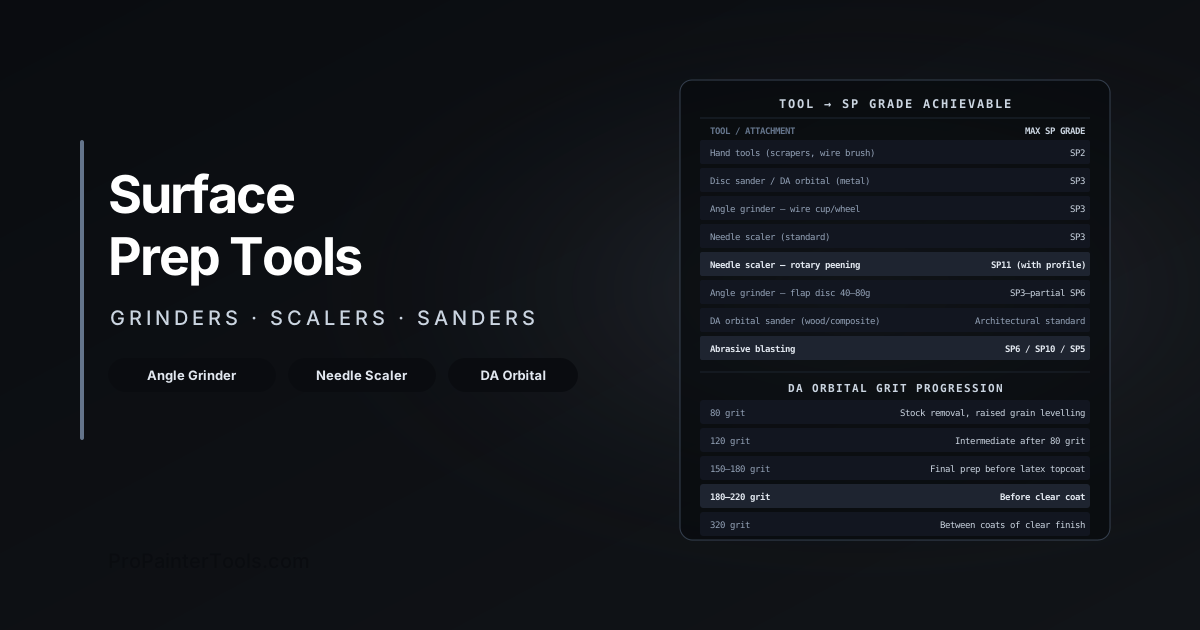
Before selecting a prep tool, the target SP grade must be determined from the coating specification or manufacturer's data sheet. The tools used determine the achievable grade:
| Tool | Maximum Achievable SSPC Grade | Typical Application |
|---|---|---|
| Hand tools (scrapers, wire brush) | SP2 | Loose rust and paint removal |
| Disc sander, grinder | SP3 | Power tool cleaning |
| Needle scaler | SP3 | Pitting and weld seams |
| Needle scaler + wire wheel | SP3 | Rough steel maintenance work |
| Angle grinder + flap disc | SP3–SP6 partial | Spot preparation |
| Angle grinder + wire cup | SP3 | Surface rust and mill scale |
| Rotating wire wheel (abrasive) | SP3 | Tight rust and old coatings |
| DA orbital (wood/composites) | N/A — architectural standard | Fine sanding, deglossing |
| Abrasive blasting | SP6 / SP10 / SP5 | Full surface blast cleaning |
SP11 exception: SSPC-SP11 (Power Tool Cleaning to Bare Metal) requires bare metal cleanliness AND a minimum 1 mil (25 micron) anchor profile. This is achievable with aggressive needle scaling or angle grinder rotary wire cup followed by profile verification — but is much slower than blast cleaning for large areas.
Angle Grinders
The 4.5" or 5" angle grinder is the most versatile surface prep tool for steel painting work. Performance depends almost entirely on the attachment used.
Wire Wheel (Knot Wire Wheel)
Removes loose rust, mill scale, and old paint from steel surfaces. The knotted wire configuration is more aggressive than standard twisted wire. Produces a SP3 surface on most substrates with multiple passes.
Use for: Spot treatment of rust, weld seams, edges, and areas inaccessible to blasting equipment. Tight rust in pits and crevices.
Limitation: Does not produce an anchor profile. Wire wheels cannot achieve SP10 regardless of operator effort — the wires deflect and do not abrade deeply enough to create consistent profile.
Safety: Wire wheels operate at very high RPM (4,500–12,000 RPM). Always use the wheel rated for the tool speed (check the maximum RPM label on the wheel). Wear full face shield — broken wires travel at high velocity.
Wire Cup Brush
A cup-shaped wire brush that covers more surface area than a wheel. Used for descaling flat and slightly curved surfaces. More aggressive than a standard wire wheel for scale removal.
Use for: Broad flat areas of moderate rust and scale.
Flap Disc
Overlapping abrasive cloth flaps provide grinding and finishing in one tool. More aggressive material removal than a sanding disc; leaves a smoother surface than a wire wheel.
Grit selection:
- 24–40 grit: aggressive material removal, paint stripping, rust removal
- 60–80 grit: intermediate grinding, blending weld seams
- 80–120 grit: deglossing and surface conditioning on ferrous metal before DTM coatings
Use for: Weld seam dressing, transition zones between blasted and existing coating, local paint removal before spot repair.
Grinding Disc (Depressed-Centre)
A rigid abrasive grinding disc for aggressive material removal — weld splatter, high spots, thick scale. Not used for surface conditioning prior to coating — too rough.
Needle Scalers
A needle scaler is an impact tool that uses a bundle of reciprocating hardened steel needles (or rods) to chip away rust, mill scale, and old coating from steel surfaces. Available in pneumatic and electric versions.
Best for:
- Irregular steel surfaces — pitting, welds, rivet heads, rough castings — where rotating tools cannot reach
- Deep rust pitting where a wire wheel skips over the surface without entering the pits
- Weld scale and splatter removal
Needle scaler types:
- Flat-faced scalers: Standard bundle of round-tip needles. Most common for steel prep.
- Multi-point chisels (rotary peening): Uses chisel-tipped needles in a rotating pattern; more aggressive and produces a better anchor profile.
SSPC SP3 vs SP11: A needle scaler alone achieves SP3 (power tool cleaning). To achieve SP11 (bare metal with minimum 1 mil profile), aggressive needle scaling with rotary-peening attachments can approach SP11 on clean steel — but this requires verification with replica tape.
Ergonomics: Needle scalers are high-vibration tools. Extended use without anti-vibration gloves causes hand-arm vibration syndrome (HAVS) over time. OSHA does not specify a vibration limit, but the EU Physical Agents (Vibration) Directive limits daily exposure — good practice is to rotate operators and use low-vibration models.
DA (Dual-Action) Orbital Sander
The DA orbital sander (also called a random orbital sander) uses a circular sanding pad that moves in an orbital and rotational pattern simultaneously, preventing the parallel scratches that a standard straight-line sander produces. The result is a finer, more random scratch pattern that accepts clear finishes and top coats without visible sanding marks.
Best for:
- Timber surfaces before painting and clear coating
- Fibreglass surfaces before coating
- Deglossing previously painted surfaces before recoating
- Cabinet and millwork preparation (see our kitchen cabinet refinishing guide)
Grit progression for timber:
- 80 grit: initial stock removal, levelling raised grain after water-based primer
- 120 grit: intermediate prep after 80 grit
- 150–180 grit: final prep before latex topcoat
- 180–220 grit: final prep before clear coat (polyurethane, varnish)
- 320 grit: scuff between coats of clear finish
Pad size: 5" is the standard for most painting prep. 6" provides more coverage on flat surfaces. 3" is available for tight areas.
Random Orbital vs Belt Sander
Random orbital sander: As above — fine to medium prep, leaves minimal sanding marks, appropriate for finishing work and deglossing large flat surfaces before repaint.
Belt sander: Uses a continuous abrasive belt running in one direction. More aggressive material removal than a DA orbital — used for stripping old paint from timber, levelling rough or uneven surfaces, removing mill glaze from new timber (see our wood substrate preparation guide). Produces directional scratch marks that require follow-up with a DA orbital or hand sanding before finish coating.
Selector:
- Stripping timber or levelling: belt sander first, DA orbital to finish
- Deglossing paint for repaint: DA orbital only
- Fine cabinet prep: DA orbital only
- Steel deglossing before DTM: DA orbital or flap disc at 120 grit
Hand Tools
Not every prep task requires power tools. Hand tools remain the primary choice for:
Scraper (pull scraper / hook scraper): Removing loose, flaking, or blistering paint from wood and masonry. The standard first step before sanding on exterior timber. Replaceable blades — keep blades sharp; a dull scraper tears wood fibres instead of cleanly removing paint.
Wire brush (hand): Removing surface rust from small areas of metal, cleaning weld seams, working into crevices inaccessible to power tools.
Sanding block: For hand sanding small areas with precision — window frames, door edges, trim details. A rigid sanding block distributes pressure evenly and prevents high spots that a hand without a block creates.
Putty knife / stiff-blade knife: Removing loose caulk, scraping window glazing compound, removing thick build-up on flat surfaces.
UHP Water Blasting (Ultra-High Pressure)
Ultra-high pressure (UHP) water jetting uses water at 20,000–40,000 psi to remove coatings, mill scale, and contamination from steel — comparable to SSPC-SP10 or SP5 cleanliness. It does not create a new anchor profile — it preserves the existing profile of a previously blasted surface.
Painter relevance: UHP is primarily a specialist industrial/infrastructure tool rather than a standard painting contractor tool. Where it is relevant for painters is in surface contamination removal on maintenance painting of structures where dry abrasive blasting is prohibited (near water, in enclosed spaces, on surfaces sensitive to dust). UHP equipment is rented or subcontracted for most painting applications.
For moisture testing of prepared concrete substrates, see our moisture testing guide. For SSPC SP grade definitions and when each is specified, see our surface preparation standards guide.
ProPainterTools allows you to specify the prep method and SSPC target grade on each project estimate, giving you a documented basis for the prep labour hours in your bid.
Frequently Asked Questions
Can I use an angle grinder with a sanding disc instead of a DA orbital for wood? The high speed of an angle grinder (10,000+ RPM) burns wood and leaves swirl marks too aggressive for painting. Use an angle grinder only on metal — use a DA orbital or random orbital for wood.
What is the difference between SSPC-SP3 and SSPC-SP11? SP3 is power tool cleaned — rust, scale, and loose paint removed, but tight scale may remain. SP11 is power tool cleaned to bare metal with a minimum 1 mil anchor profile. SP11 is only achievable with aggressive rotary power tools and requires profile verification. SP3 is achievable with standard grinding, disc sanding, or needle scaling.
How do I know when to use a needle scaler vs an angle grinder for rust removal? Use a needle scaler on irregular, pitted, or heavily corroded surfaces — it enters pits and weld zones that a rotating tool cannot reach. Use an angle grinder wire cup or flap disc on relatively smooth or moderately corroded flat surfaces where speed is the priority.
Do surface prep tools need to be cleaned before use on a new project? Wire wheels and wire cups pick up contaminants (oil, paint, scale) that can be transferred to a new surface. For critical painting applications (high-performance industrial coatings), clean or replace wire attachments when moving from one substrate condition to another.
