Paint Primers Guide — When to Prime, Which Primer, and How to Select by Substrate
14 March 2026 · ProPainterTools
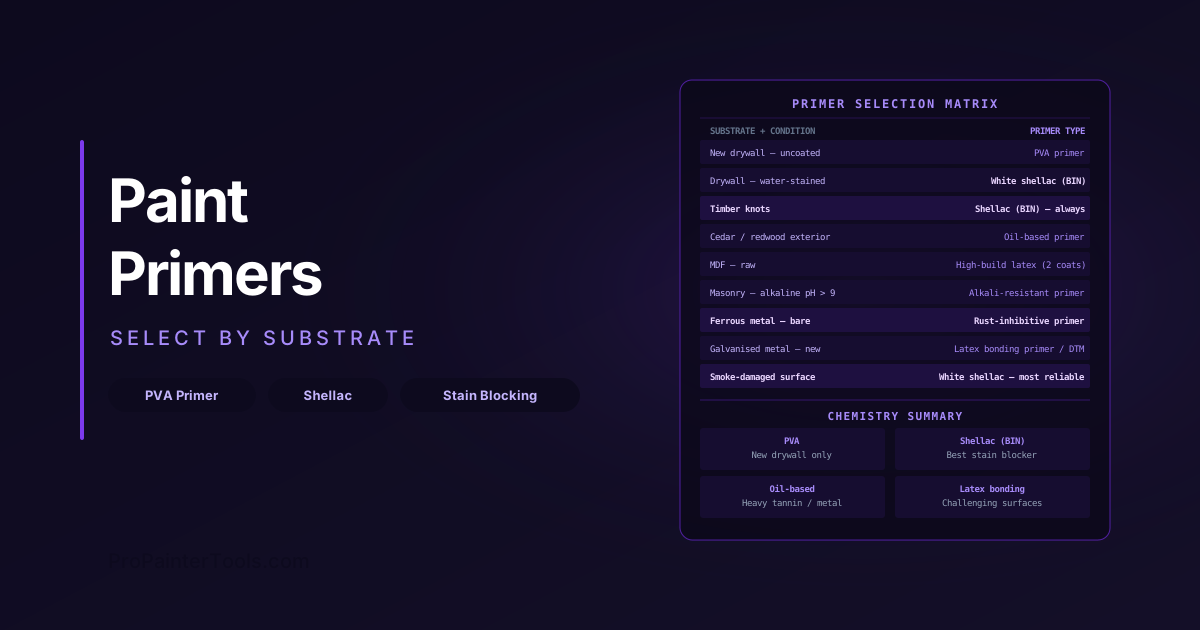
Paint Primers Guide: When to Prime, Which Primer, and How to Select by Substrate
Primer selection is one of the highest-leverage decisions in a coating specification. The correct primer bridges the gap between a substrate's absorption, pH, or contamination characteristics and the topcoat's adhesion requirements. The wrong primer — or skipping primer altogether — produces poor adhesion, uneven sheen, tannin bleed-through, and costly callbacks. This guide covers the function of primer, how to match primer chemistry to substrate conditions, and how to read primer product data sheets for the information that actually matters.
What Primer Does
Primer serves several distinct functions, not all of which are provided by every primer product:
Adhesion promotion: Many substrates are difficult for topcoats to bond directly to — glossy paint, chalky existing coatings, dense or smooth masonry, non-ferrous metals, and plastic. Primers contain adhesion-promoting chemistry (tackifiers, etching agents, or physical tooth from the primer film) that bridges this gap.
Sealing and uniformity: Porous substrates like new drywall, raw timber, and masonry absorb the vehicle from a topcoat unevenly, causing sheen variation (flashing). A sealing primer saturates the substrate and provides a uniform base coat.
Stain blocking: Certain contaminants — tannins (from wood knots, cedar, redwood), water stains, smoke, grease, and nicotine — will bleed through water-borne topcoats without a stain-blocking layer. Stain blockers work by chemical isolation of the stain.
Corrosion inhibition: Metal primers contain corrosion inhibitors (zinc phosphate, zinc chromate, or zinc metal) that electrochemically protect the substrate. This function is absent from architectural primers designed for masonry or timber.
Film build: Some primers add total system DFT, particularly block filler primers used on porous masonry.
Primer Chemistry Types
PVA Primer (Polyvinyl Acetate)
For: New, uncoated drywall (gypsum board). Also appropriate for new plaster.
Function: Seals the paper face and joint compound, equalising porosity for even topcoat sheen. PVA primers dry fast (30–60 minutes) and sand well.
Limitations: Not a stain blocker. Not appropriate for existing painted surfaces, timber, metal, or any substrate where adhesion promotion or stain blocking is needed. Using PVA on anything other than new drywall or plaster is a misapplication.
Latex (Acrylic) Primer
For: General-purpose priming of previously painted surfaces, timber, masonry, and drywall. The most versatile category.
Function: Good adhesion to a wide range of substrates, flexible film, water cleanup, fast dry. Premium latex primers include stain-blocking agents for mild staining.
Grades within latex primer:
- Standard latex primer: interior painted surfaces, new drywall in less critical applications
- High-build latex primer: fills minor surface imperfections, suitable for block filler applications
- Bonding primer (latex): modified with adhesion promoters for glossy or challenging surfaces (PVC, glazed tile, previously gloss-painted surfaces)
Oil-Based (Alkyd) Primer
For: Wood with heavy tannin, exterior timber, ferrous metal.
Function: Penetrates timber grain deeply, providing excellent adhesion and tannin-blocking performance. Provides a hard, sandable surface under oil or latex topcoats.
Limitations: Longer dry time (4–8 hours), solvent cleanup, higher VOC. Many jurisdictions restrict or prohibit alkyd primers — check CARB/OTC limits for your location. Slow to recoat; in production work, latex alternatives (modified or specialty) are often specified for speed.
Note for timber: Oil-based primers are the traditional specification for raw timber before oil-based topcoats. Under modern acrylic topcoats on timber, a high-quality latex primer is generally appropriate. Oil-based primer remains preferred for dense hardwoods with heavy tannin (oak, cherry) and for exterior softwood exposed to extreme weathering.
Shellac-Based Primer
For: Severe stain blocking — smoke damage, nicotine, water stains (amber), heavy tannin, grease, and any stain that has failed with latex primer.
Function: Shellac is a natural resin dissolved in alcohol (denatured alcohol or isopropanol). It forms a very hard, impermeable film that chemically isolates virtually any stain. It is the most reliable stain blocker available.
Trade name: Zinsser BIN is the benchmark product in this category.
Limitations: Strong solvent (alcohol) odour — requires excellent ventilation. Not paintable until dry (45–60 minutes typically). Brittle film — do not use on flexible substrates or large timber sections that will move. Alcohol solvent is flammable. Not for exterior use.
White Pigmented Shellac vs Clear Shellac
White (pigmented) shellac (BIN) provides stain blocking AND hiding. Clear shellac (Zinsser SealCoat) seals but provides minimal stain blocking — it is a sealer, not a stain blocker. Use white shellac for stains.
Solvent-Borne Stain Blocker (Oil-Based Stain Block)
For: Heavy stains on surfaces where shellac is not appropriate — odour, large areas, or when a harder film is needed.
Function: Oil-based stain blockers (Zinsser Cover-Stain, Kilz Original) provide excellent stain blocking for most stains at lower cost than shellac for large areas. Performance is close to shellac for most stains; shellac still wins for severe smoke and water stains.
Substrate Primer Matrix
| Substrate | Condition | Recommended Primer | Notes |
|---|---|---|---|
| New drywall | Unpainted | PVA primer | Do not use shellac or oil on fresh drywall |
| New drywall | Patched with compound | PVA or latex | Prime patches before topcoat |
| Previously painted drywall | Sound | Latex primer or direct topcoat | Prime if switching from flat to gloss |
| Drywall | Water-stained | White shellac (BIN) | Oil-based stain block also acceptable |
| Softwood timber — interior | Raw, light tannin | Latex or oil-based primer | Oil provides better penetration |
| Softwood — knots | Any | Shellac (BIN) | Knots bleed through everything else |
| Hardwood — oak, cherry | Raw | Oil-based primer | Heavy tannin; latex primer inadequate |
| Cedar / redwood | Exterior | Oil-based primer | Very high tannin; latex usually fails |
| MDF | Raw | High-build latex primer | Absorbs heavily; two coats often needed |
| Masonry — new | Unpainted | Masonry latex primer | Allow full cure (28 days for concrete) |
| Masonry — alkaline (pH > 9) | Any | Alkali-resistant primer | Standard primer saponifies in high pH |
| Ferrous metal | Bare | Rust-inhibitive primer (oil or latex) | Must contain corrosion inhibitor |
| Galvanised metal | New | Latex bonding primer or DTM | Alkyd saponifies on galvanised zinc |
| Aluminium | Bare | Self-etching or conversion primer | Or scuff well with 120-grit + bonding primer |
| Plastic (primed) | Previously painted | Bonding primer | Use adhesion test to verify before full application |
| Smoke-damaged surface | Any | White shellac | Most reliable for smoke and nicotine |
Reading a Primer PDS: What Matters
When reviewing a primer product data sheet, the key values to check:
- Dry time (touch dry / hard dry / recoat): Touch dry tells you when to handle; recoat time tells you when the topcoat can go on. These are at standard temperature — at lower temperatures or higher humidity, multiply by 1.5–3x.
- Spreading rate: In m² per litre at recommended DFT. Cross-check against your area to calculate volume.
- Coverage per coat: Primer DFT is typically 1.5–3 mils. Verify film build before specifying number of coats.
- Topcoat compatibility: Primers are not universally compatible with all topcoats. An oil-based primer under a water-borne topcoat requires full cure (typically 24–48 hours) before topcoat application. PVA primer accepts latex only.
- Thinner / cleanup: Defines what the carrier is — water, alcohol, or solvent. Affects ventilation, personal protective equipment, and disposal requirements.
When Skipping Primer Costs More
In production residential work, the pressure to skip primer coats is constant. The calculation must include the callback cost:
- New drywall without PVA primer: Sheen variation (flashing) that is visible in raking light. Typically requires a third coat to correct, or complete reprime and re-topcoat.
- Timber knots without shellac: Tannin bleed-through visible within weeks. Requires sanding back and spot-treating with shellac, followed by two topcoats to recover.
- Smoke-damaged walls without stain blocker: Stain re-emerges through three coats of standard latex. Requires total strip and reprime.
- New masonry without alkali-resistant primer: Saponification of the primer film — the film becomes soft, soapy, and delaminating. Full strip and reprime required.
The cost of a primer coat is a fraction of the cost of a callback.
For more on drywall preparation and primer selection for repairs, see our drywall repair for painters guide. For metal primer selection in industrial contexts, see our industrial metal finishes guide. For exterior timber primer selection, see wood substrate preparation.
ProPainterTools allows you to specify the full coating system — primer type, topcoat, number of coats, and DFT — on each project estimate and client document, building the professional paper trail that protects your warranty.
Frequently Asked Questions
Can I use a paint-and-primer-in-one product instead of a separate primer? For previously painted, clean surfaces in good condition, a high-quality paint-and-primer product is often adequate. For new drywall, bare wood, stained surfaces, or substrate changes, a separate primer is required — the paint-and-primer-in-one designation is a marketing category, not a substitute for genuine sealing or stain-blocking chemistry.
Do I need to sand between primer and topcoat? Light sanding (180–220 grit) between primer and topcoat improves adhesion and removes nibs, producing a smoother final finish. On smooth surfaces being painted with satin or higher, it is good practice. On previously painted walls being rolled, it is typically skipped.
How many coats of primer should I apply? One coat is standard. Two coats of primer are warranted for: bare, heavily porous masonry or MDF; severe smoke or water stain situations; and when spot-priming produces visible variation in sheen (indicating uneven absorption that requires a second sealing coat).
Is bonding primer the same as regular primer? No. Bonding primers contain adhesion promoters specifically formulated to adhere to difficult surfaces — glossy paint, glazed surfaces, non-porous substrates. They are not required on absorbent or standard surfaces, and using them unnecessarily adds cost without benefit.
