Industrial Metal Finishes — Corrosion Control Coatings for Professional Painters
28 March 2026 · ProPainterTools
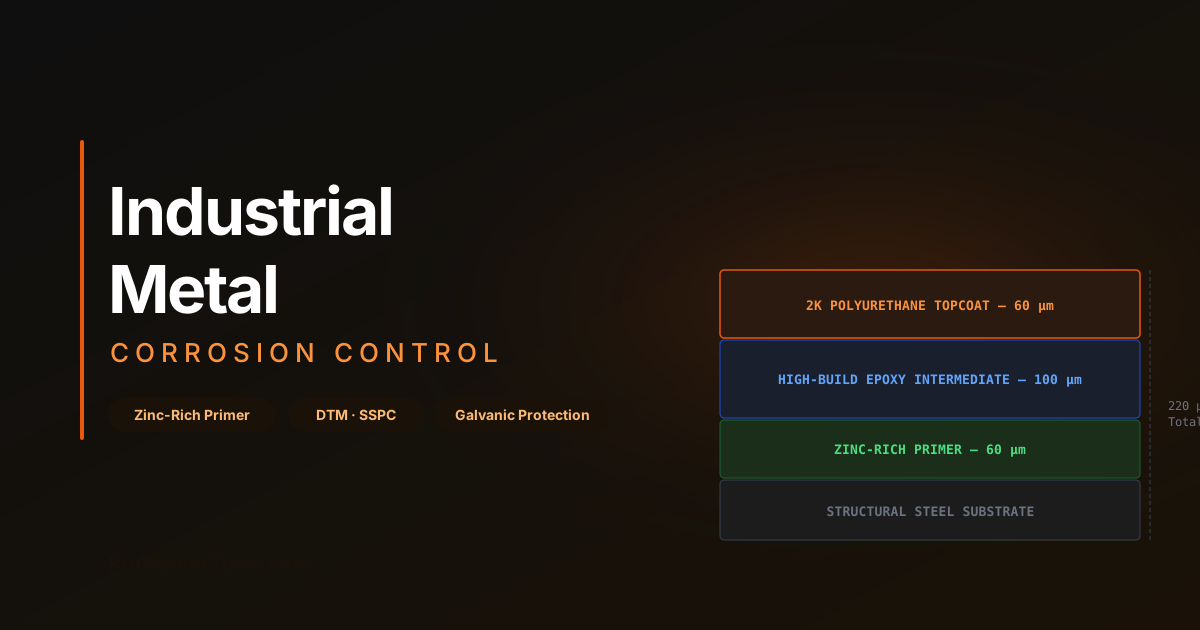
Industrial Metal Finishes: Corrosion Control Coatings for Professional Painters
Corrosion destroys unprotected steel at a rate of approximately 1.3 mm per year in industrial environments — and coating failure is the leading cause of premature structural steel deterioration. For painting contractors working on industrial facilities, structural steel, bridges, or commercial buildings, understanding corrosion control coating systems is a prerequisite for winning and executing high-value work. This guide covers the principles of galvanic protection, the zinc primer types used in industrial work, direct-to-metal coatings, and how to specify and apply a complete corrosion control system.
Why Corrosion is a Coating Problem
Steel corrodes because of an electrochemical reaction: in the presence of moisture and oxygen, iron atoms lose electrons and form iron oxide (rust). A correctly designed and applied coating system interrupts this reaction in three ways:
- Barrier protection — the coating film physically excludes moisture and oxygen from the steel surface
- Galvanic (cathodic) protection — zinc-rich primers sacrifice themselves electrochemically, protecting the steel even where the coating is scratched or breached
- Inhibitive protection — certain pigments (zinc phosphate, calcium-exchange silica) react with moisture to form a passivating layer on the steel surface
A complete corrosion control system typically uses all three mechanisms in sequence: zinc primer (galvanic + inhibitive) → epoxy intermediate coat (barrier build) → polyurethane topcoat (UV stability and aesthetics).
Galvanic Corrosion and Sacrificial Protection
The galvanic series ranks metals by their electrochemical potential. When two dissimilar metals are in electrical contact in the presence of an electrolyte (moisture), the more active (anodic) metal corrodes preferentially, protecting the more noble (cathodic) metal.
Zinc (−0.76 V) is significantly more anodic than steel (−0.44 V). When zinc-rich primer is applied to steel, the zinc particles in the primer form a galvanic couple with the steel substrate. Any breach in the coating — a scratch, a weld seam, a cut edge — causes the zinc in the adjacent primer to corrode preferentially, preventing rust creep under the film. This is the same principle as hot-dip galvanising, achieved in a paint system.
For galvanic protection to function correctly, the zinc particles in the primer must be in electrical contact with each other and with the steel. This requires:
- A minimum zinc dust content of approximately 65–85% by weight in the dry film (the exact threshold varies by standard)
- A properly blast-cleaned steel surface — typically SSPC-SP6 as a minimum, SSPC-SP10 for immersion service — to ensure direct metallic contact between primer and substrate
Zinc-Rich Primers: Inorganic vs Organic
Inorganic Zinc-Rich Primers
Inorganic zinc primers use an ethyl silicate or potassium silicate binder. After application, atmospheric moisture hydrolyses the silicate binder, producing a hard inorganic matrix that bonds directly to the steel. They offer the highest level of galvanic protection and outstanding heat resistance (up to 400°C continuous for some formulations).
Advantages:
- Exceptional galvanic protection — zinc loading up to 85% by weight in the dry film
- Chemical resistance to solvents, fuels, and industrial chemicals
- Excellent adhesion when applied to blast-cleaned steel
- Long overcoat window — can often be left for months before topcoating
Limitations:
- Require SSPC-SP10 blast cleaning — they will not bond correctly to anything less
- Very short pot life once mixed (4–8 hours)
- Require moderate humidity (>50% RH) during curing — the moisture drives the silicate hydrolysis reaction
- Topcoat must be applied carefully — epoxy intermediate coats must be applied as a thinned mist coat first to avoid mud-cracking over the porous zinc surface
Typical applications: Bridges, structural steel in aggressive environments, offshore structures, chemical plant steelwork.
Organic Zinc-Rich Primers
Organic zinc primers use an epoxy or polyurethane binder. They offer comparable galvanic protection to inorganic zinc with more forgiving application tolerances and broader overcoat compatibility.
Advantages:
- Less critical surface preparation requirement (SSPC-SP6 acceptable for many atmospheric exposures)
- Compatible with most epoxy and polyurethane overcoat systems without a special mist coat procedure
- Can be applied in lower humidity conditions than inorganic zinc
Limitations:
- Lower heat resistance than inorganic zinc (100–120°C typical maximum)
- Higher binder content reduces zinc loading slightly compared to the best inorganic formulations
- 2K formulations have pot life limitations like other epoxy systems
Typical applications: Commercial steel structures, industrial buildings, maintenance painting over previously coated steelwork.
Direct-to-Metal (DTM) Coatings
DTM coatings are single-product systems formulated to act as both primer and topcoat on steel, eliminating the need for a separate primer coat. They are a practical choice for maintenance repainting, minor steelwork, and projects where a full three-coat specification is not required.
DTM acrylics are the most common type: waterborne, fast-drying, with corrosion-inhibiting pigments. They are appropriate for low- to medium-exposure environments but are not a substitute for a zinc primer system where corrosion risk is significant.
When to use DTM:
- Interior structural steel in non-aggressive environments
- Ornamental ironwork and architectural metalwork
- Maintenance touch-up over existing sound coating systems
- Projects where surface preparation is limited to SSPC-SP3 or SP6
When NOT to use DTM:
- Immersion service (water tanks, pipework)
- High-humidity or chemical industrial environments
- Coastal or marine exposure
- Projects where the coating specification explicitly calls for a zinc-rich primer system
A Standard Three-Coat System for Structural Steel
For structural steel in atmospheric exposure (bridges, industrial buildings, commercial structures), the industry-standard specification is:
| Coat | Product Type | DFT | Surface Prep |
|---|---|---|---|
| Primer | Zinc-rich epoxy | 50–75 µm | SSPC-SP10 minimum |
| Intermediate | High-build epoxy | 75–125 µm | Overcoat within window |
| Topcoat | 2K aliphatic polyurethane | 50–75 µm | Scuff sand if needed |
Total system DFT: 175–275 µm. For aggressive environments (coastal, chemical, high humidity), increase intermediate coat DFT to 150–200 µm per coat, or add a second intermediate coat.
Surface preparation is non-negotiable. A zinc-rich primer over hand-tool-cleaned steel (SP2/SP3) will not bond correctly and provides no effective galvanic protection. Review the full preparation requirements in our surface preparation standards guide — for most zinc primer systems, SSPC-SP10 blast cleaning with a 2.0–3.5 mil (50–90 µm) anchor profile is the minimum requirement.
For a full overview of how each resin type performs across different substrates and environments, see our professional coating guide. For detailed application discipline on the 2K aliphatic polyurethane topcoat — mix ratios, pot life management, isocyanate safety, and re-coat windows — see our two-component 2K coating systems guide. For commercial steel structures requiring passive fire protection, see our intumescent fire-retardant coatings guide.
Coating Compatibility for Steel Systems
The three-coat system works because each layer is compatible with the next. Critical points:
Mist coat the inorganic zinc: Apply a thinned epoxy mist coat (10–15% reduction by volume) before the full intermediate coat. This seals the porous zinc surface and prevents solvent popping and mud-cracking in the epoxy.
Observe overcoat windows: All coatings have a minimum and maximum recoat window. Applying too early (before sufficient cure) can cause wrinkling or delamination. Applying too late (UV-degraded or contaminated surface) requires scuff sanding before the next coat.
Anchor profile for zinc primers: A profile that is too shallow (below 1.5 mils) provides inadequate mechanical bite for inorganic zinc. A profile that is too deep (above 4.0 mils) can cause peak protrusion through the thin zinc layer, creating rust points. Measure with Testex replica tape and verify against the primer data sheet.
Frequently Asked Questions
What is the minimum surface preparation for zinc primer? Inorganic zinc primers require SSPC-SP10 (near-white blast) as a minimum. Organic zinc-rich epoxy primers typically require SSPC-SP6 (commercial blast) for atmospheric service and SP10 for immersion. Neither type is suitable over mill scale, rust, or hand-tool-cleaned surfaces — the zinc must have direct metallic contact with the steel substrate.
Can I apply an epoxy topcoat directly over inorganic zinc? Not as a full build coat directly. Apply a thinned epoxy mist coat (10–15% by volume reduction) first to penetrate the porous zinc surface. Once the mist coat has cured, apply the full intermediate build coat. Skipping the mist coat causes pinholes and mud-cracking in the epoxy.
What is the difference between zinc primer and hot-dip galvanising? Zinc primers are applied coatings that provide galvanic protection through zinc dust suspended in the binder. Hot-dip galvanising metallurgically bonds a continuous zinc layer to the steel. Galvanised steel requires specific preparation (SSPC-SP16 or sweep blast) before painting — standard zinc primers are not applied over galvanised steel.
How long does a zinc-epoxy-polyurethane system last? In a typical industrial atmospheric environment, 20–30 years is achievable with SSPC-SP10 surface preparation and correct application. Coastal and chemical environments shorten service life; maintenance painting at 10–15 years may be needed in aggressive exposures. The primer is the critical layer — it determines the system's lifespan.
For coating system specifications, consult SSPC-PA 1 (Application of Liquid Applied Coatings) and SSPC-PS 12.00 (Guide for Selecting Protective Coatings for Use Over Zinc-Rich Primers) from the AMPP standards library.
