Intumescent and Fire-Retardant Coatings — Specification, Application, and Certification
4 April 2026 · ProPainterTools
Intumescent and Fire-Retardant Coatings: Specification, Application, and Certification
Intumescent and fire-retardant coatings fall within a specialised category of passive fire protection (PFP) — products whose primary function is to delay the transmission of heat to a structural element or to retard the spread of flame across a surface. For painting contractors, this represents a technically demanding and liability-carrying scope of work: the specification, application, and quality assurance requirements are more rigorous than standard decorative coatings, and the stakes of incorrect application are significant. This guide covers the two main product categories (intumescent and fire-retardant), how they work, certification requirements, and the critical application quality controls.
Two Distinct Product Categories
Intumescent Coatings (Structural Fire Protection)
Intumescent coatings are used primarily to protect structural steel members from heat collapse during a building fire. When exposed to heat (typically activating between 200°C and 300°C), the coating undergoes a chemical reaction that causes it to expand dramatically — typically 30–100 times its original thickness — forming a low-density, insulating char layer. This char layer slows the rate of heat transmission to the steel, buying time for building evacuation and firefighting.
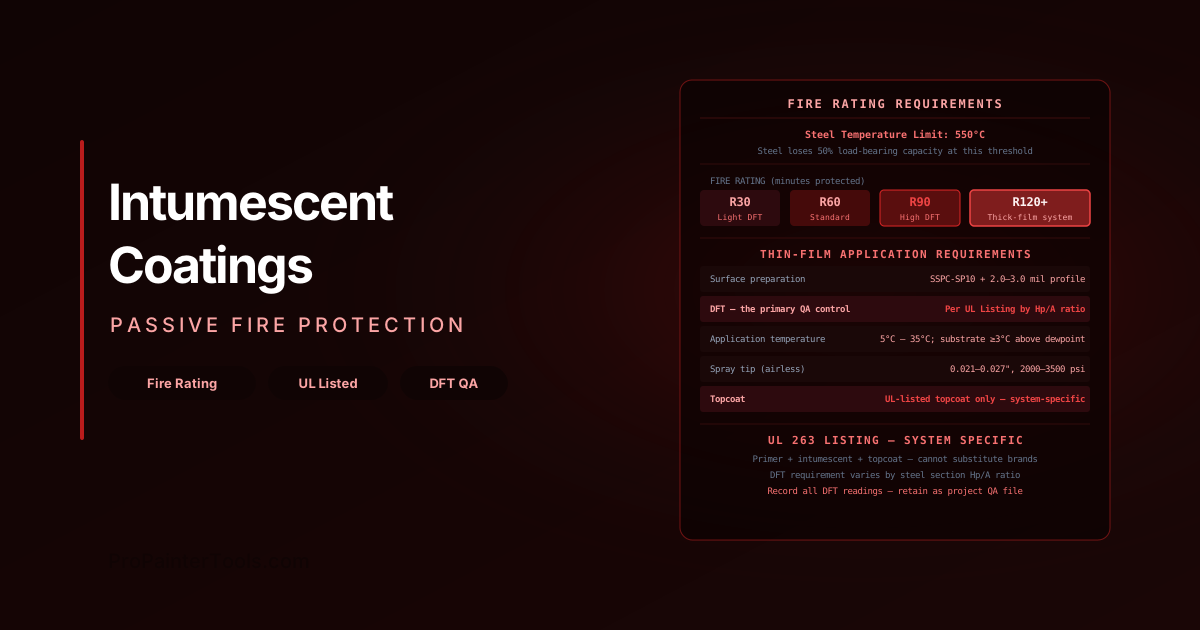
Structural steel loses approximately 50% of its load-bearing capacity at 550°C. Intumescent protection is specified to maintain steel temperature below this threshold for a defined fire rating period — typically 30, 60, 90, or 120 minutes, expressed as R30, R60, R90, R120.
Thin-film intumescent (TFI): Applied at a DFT (dry film thickness) of approximately 0.5–6 mm in most specifications. The most common system for structural steel in commercial and industrial buildings. Applied by brush, roller, or airless spray.
Thick-film intumescent: Cementitious or epoxy-based systems applied at 10–50 mm thickness. Used on heavy steel sections requiring long fire ratings (R120 or R240) and in harsh environments (offshore, chemical plant, car parks). Applied by specialist applicators using specific spray equipment; not a painting contractor scope.
Fire-Retardant Coatings (Surface Spread of Flame)
Fire-retardant coatings are applied to building materials — timber, plywood, MDF, textiles — to reduce the rate of surface flame spread in a fire. They do not protect structural elements from collapse; they retard ignition and slow the spread of flame across the coated surface.
These products are relevant to:
- Exposed timber structures (feature beams, roof trusses) required to meet regulatory flame-spread ratings
- Scenic construction for theatres, events, and film sets
- MDF shopfitting and display work in public buildings
- Timber facade cladding in jurisdictions that permit it with fire treatment
Mechanism: Fire-retardant coatings work by one or more of the following: forming a char layer that blocks oxygen (similar to intumescent mechanism at lower expansion ratios); releasing fire-suppressing gases when heated; or reducing the thermal decomposition temperature of the substrate.
Certification and Approval
UL Listings (North America)
In the United States and Canada, intumescent coating systems for structural steel are tested and listed under UL 263 (Fire Tests of Building Construction and Materials, equivalent to ASTM E119). The UL Listing specifies:
- The exact product system (primer + intumescent + topcoat) that was tested
- The steel section size and Hp/A ratio (heated perimeter to cross-sectional area) at which the rating applies
- The required DFT at each section size for each fire rating
A UL Listing is system-specific and section-specific — the listed intumescent cannot be substituted for another brand's product, the primer cannot be changed, and the DFT must be within the listed range for the steel section being protected. Departing from the listing voids the fire rating.
Hp/A ratio: Heavier steel sections have more thermal mass per unit of surface area (lower Hp/A) and require less intumescent film to achieve the same rating than light, slender sections (high Hp/A). Specifying DFT for intumescent always requires knowing the Hp/A ratio of the steel being protected — this information comes from the structural drawings.
European CE Marking (EN 13381)
In European jurisdictions, intumescent systems are tested to EN 13381 standards and carry CE marking. The European system uses the concept of the "critical temperature" approach and thickness maps published by the manufacturer.
Flame-Spread Classifications (Timber and Surface Materials)
| Standard | Classification | Description |
|---|---|---|
| ASTM E84 / UL 723 | Class A (flame spread 0–25) | Required for most commercial interior applications |
| ASTM E84 / UL 723 | Class B (25–75) | Secondary occupancy uses |
| ASTM E84 / UL 723 | Class C (75–200) | Low-occupancy, limited use |
| BS 476 Part 7 (UK) | Class 1 / Class 2 | Similar surface spread ratings |
Fire-retardant coatings for timber are tested with the ASTM E84 (Steiner Tunnel Test) to confirm they achieve the required classification. The coating manufacturer's testing applies only to the specific substrate and coating thickness tested — applying a fire-retardant coating to a different species or different thickness is not automatically covered by the test data.
Application Requirements
Thin-Film Intumescent on Steel
Surface preparation: SSPC-SP10 (Near-White Metal Blast) is typically specified, with a 2.0–3.0 mil anchor profile. Intumescent coatings are sensitive to contamination and inadequate surface profile. See our surface prep standards guide for SSPC-SP10 requirements.
Primer: The specific UL-listed primer must be used. Primer DFT must be within the listed range (typically 1.0–2.5 mils DFT). Primer DFT must be verified before intumescent application.
Intumescent application:
- By spray (airless): typical tip size 0.021–0.027", 2000–3500 psi. Multiple passes required to build to the specified DFT without runs.
- By brush or roller: appropriate for small areas or touch-up; very difficult to achieve uniform DFT on complex sections with brush alone.
- Apply in multiple thin coats to avoid sagging on vertical and overhead surfaces.
- Each coat must be within the manufacturer's re-coat window.
- Do not apply below 5°C or above 35°C. Do not apply to a surface that is damp or in direct sun with elevated surface temperature.
DFT verification: DFT measurement is not optional — it is the primary quality control for intumescent work. Use a magnetic dry film thickness gauge (per SSPC-PA2) on each structural section. Readings that fall below the minimum DFT for the section's Hp/A ratio require additional material. Readings above maximum DFT for the listed range can also be non-compliant (excess thickness can cause the char to slump off during a fire). Record all readings and retain as part of the project quality file.
Topcoat: The listed topcoat must be applied over the intumescent within the re-coat window specified. The topcoat protects the intumescent from moisture, UV, and mechanical damage — an unprotected intumescent system will deteriorate. The topcoat must not significantly impede the intumescent reaction (hence the system-specific listing requirement).
Fire-Retardant Coatings on Timber
- Apply to clean, dry timber (moisture content ≤15%)
- Apply at the coverage rate specified in the product approval — not less, or the tested performance is not achieved
- Water-based fire-retardant coatings can raise the grain of raw timber — sand lightly between coats
- Some fire-retardant formulations are sensitive to overcoating with standard paints — verify compatibility. Some standard paints applied over a fire-retardant coating can impair the fire-retardant function by forming an impermeable barrier that prevents the FRC from acting
Contractor Certification and Liability
Intumescent work on commercial or public buildings typically requires:
- Documentation of the UL-listed system being applied, including product data sheets and the relevant UL design number
- Quality assurance records — DFT logs by section, signed by the applicator, often witnessed by a third-party inspection agency
- Applicator certification — some specifiers and owners require third-party or manufacturer certification for intumescent application contractors
- Manufacturer technical sign-off for complex projects
The liability exposure for incorrect intumescent application is substantial — a fire protection failure in a building resulting from incorrect DFT is a serious professional and legal risk. If your scope includes structural intumescent on a commercial project, ensure your insurance covers passive fire protection work specifically.
ProPainterTools helps you document passive fire protection scope on project records, including the UL design number, primer and intumescent product details, target DFT by section, and actual DFT log entries — creating the quality audit trail required for commercial fire protection certification.
For surface preparation standards relevant to intumescent work, see our surface prep standards guide. For other high-performance industrial coating systems, see our 2K coating systems guide.
Frequently Asked Questions
Can I apply a regular paint over intumescent coating? Only if the topcoat is within the UL-listed system. Applying a non-listed topcoat over a listed intumescent voids the fire rating. The topcoat type and DFT are part of the listing.
How thick is a thin-film intumescent system? In appearance, thin-film intumescent looks like a normal, slightly thicker paint coat on the steel. At 1.5 mm (1500 microns) DFT, it is visible but not thick. When it expands in a fire, it can become 50–100 mm of char — 30–60 times the applied thickness.
Does intumescent coating need to be maintained? Yes. Intumescent coatings have a service life — typically 10–25 years depending on the environment and whether interior or exterior — and the building maintenance schedule should include inspection of the fire protection system. Damaged, delaminating, or wet-damaged areas must be repaired by a qualified contractor following the listed repair procedure.
Do fire-retardant coatings make timber fireproof? No. They reduce the surface spread of flame and retard ignition, but the timber will still burn if exposed to sufficient heat for sufficient time. Fire-retardant coatings buy time — they do not create a non-combustible material.
