New Home Builder Painting — Production Scheduling, Spray Methods, and Builder Contracts
25 April 2026 · ProPainterTools
New Home Builder Painting: Production Scheduling, Spray Methods, and Builder Contracts
Production painting for home builders is a different business model from residential repaint or commercial painting. Volume replaces premium — you paint many units at consistent quality and speed rather than one exceptional job. The margin per square metre is lower, but the scheduling predictability and volume make it attractive for contractors who can execute the operational requirements. Builder painting requires understanding the construction sequencing logic, producing reliable production output, and managing the contractual obligations of the GC relationship. This guide covers the operational approach that makes builder painting profitable.
The Builder Relationship
How Builders Select Painting Subcontractors
Home builders select painting subcontractors differently from commercial GCs. The primary criteria are:
- Production rate: Can you reliably complete a unit within the allocated schedule window? A builder who schedules painting on day 80 of a 90-day build cycle needs the painting crew out by day 85, regardless of what other trades did or did not complete before you arrived. Schedule reliability is the primary competency being evaluated.
- Consistent quality: Builder painting is specification-driven — the paint schedule (product, sheen, colour) is fixed. The quality standard is "no visible defects from 4 feet in normal lighting." Holiday, sag, runs, and missed areas are punch list items. The builder wants zero punch list from painting.
- Price: Builder painting is competitive — multiple contractors bid per-unit or per-SF. The margin per unit is lower than residential repaint; volume compensates.
- Capacity: A builder with 15 units per month in various stages needs a subcontractor who can run multiple crews simultaneously. Single-crew contractors are not viable partners for volume builders.
How to approach builders: Call or email the site superintendent for active builds in your area. Introduce your business, ask whether they have a painting subcontractor relationship, and request an opportunity to bid the next phase. Builders who are unhappy with their current painter (schedule, quality, or communication) are receptive to alternatives.
Prime-and-Hang vs Hang-and-Prime Workflow
This is the most consequential scheduling decision in new home builder painting. The two workflows differ in when drywall hanging and primer application occur relative to each other.
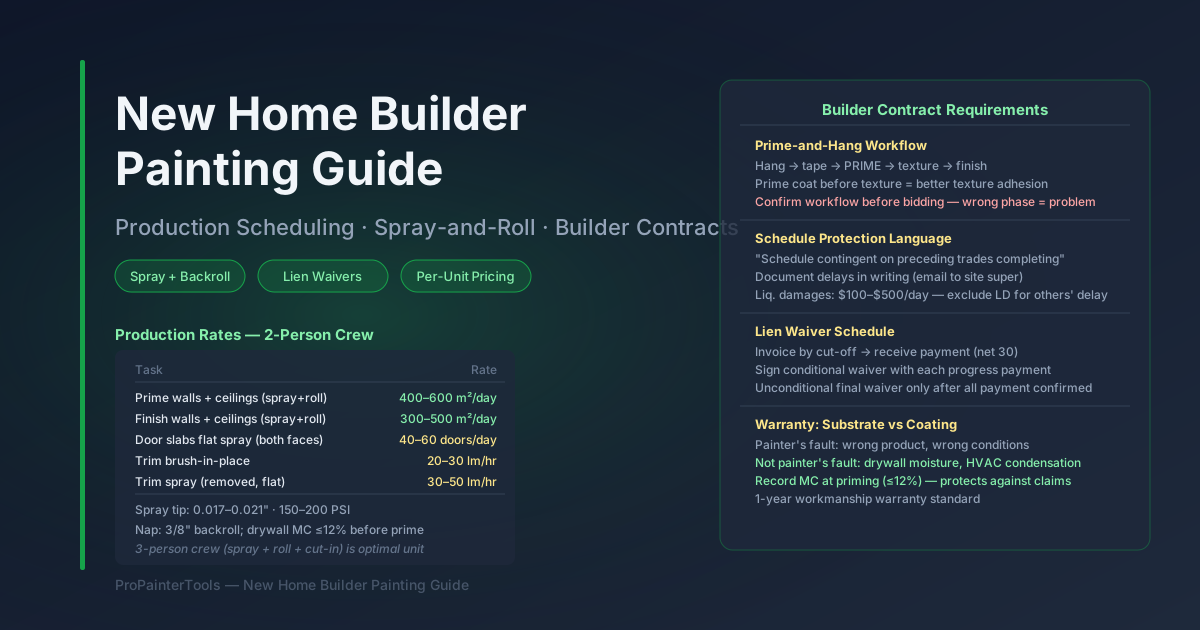
Prime-and-Hang (Hang, Tape, Prime, Texture, Finish)
The most common sequence in US residential new construction:
- Drywall hung and taped
- Finish paint (prime coat) applied to all walls and ceilings before texture
- Texture applied over the primed surfaces
- Finish coats applied after texture
Why builders use this: Applying primer before texture means the texture binds to the primer rather than directly to the drywall paper. This produces better texture adhesion and easier touchup. The primer coat also seals the drywall paper before texture, reducing texture cracking as the paper absorbs moisture from the texture compound.
Painter's role in prime-and-hang: The prime coat must be applied after taping is complete and the compound is fully dry — but before texture is sprayed. Your scheduling window is tight. Confirm with the site superintendent when taping will be complete and when texture is scheduled. A one-day window between tape and texture is common on production builds.
Hang-and-Prime (Hang, Tape, Texture, Prime, Finish)
Less common; used when texture is applied to bare drywall:
- Drywall hung and taped
- Texture applied to bare drywall
- Primer coat applied over texture
- Finish coats applied
Painter's role in hang-and-prime: Priming over texture is the first painter visit. The prime coat seals the texture and paper face uniformly before finish coats.
Critical: Confirm which workflow the builder uses before bidding. Misunderstanding the sequence leads to being present at the wrong phase, which disrupts the schedule and damages the builder relationship.
Production Rates for New Build Interiors
Builder painting production rates are significantly higher than residential repaint because surfaces are clean, continuous, and unobstructed. The standard crew for production builder painting is 2–3 painters.
Spray-and-Roll Method
The production standard for new build interior walls and ceilings:
- Spray: One painter operates the airless sprayer (0.017–0.021" tip, 150–200 PSI) applying product at high speed — typically 20–30m² per minute walking rate, factoring setup and movement.
- Backroll: One painter follows with a 3/8" or 1/2" nap roller, immediately rolling the wet spray coat into the surface. Backrolling eliminates orange-peel texture from the sprayer and produces the smooth, uniform film required for drywall.
Why backrolling matters: On new drywall, airless spray without backrolling produces visible surface profile variation — particularly with sheens above flat. Builder specification typically calls for finish-level smoothness; backrolling consistently achieves this.
Production Rate Targets
| Task | Rate (2-person crew) |
|---|---|
| Prime walls + ceilings — spray + backroll | 400–600 m²/day |
| Finish coat walls + ceilings — spray + backroll | 300–500 m²/day |
| Trim — spray (pre-hung, sprayed flat in shop) | 30–50 doors/day |
| Trim — brush (in place) | 20–30 lm/hr |
| Touch-up (brush/roller) | Varies by punch list |
Door spraying flat: Production builders often schedule all door slabs to be removed, sprayed flat (both faces), and re-hung as a single operation. One painter with an efficient setup can spray 40–60 doors per day (both faces). Door slabs are laid on sawhorses at working height, sprayed, flipped after tack, and re-sprayed. The doors are re-hung after cure — typically the following morning.
Production Paint Schedule
Builder specifications define the paint schedule — product, sheen, and colour assignment by surface. A typical production builder paint schedule:
| Surface | Product Spec | Sheen | Colour |
|---|---|---|---|
| Walls | SW ProMar 200 or equiv. | Flat or eggshell | Per colour plan |
| Ceilings | SW ProMar 200 Flat or equiv. | Flat | White or off-white |
| Trim and doors | SW ProMar 200 Extra White | Semi-gloss | White |
| Closets (optional) | ProMar 200 | Flat | Same as adjacent room |
Painter-furnished vs builder-furnished paint: Builder contracts are typically painter-furnished — you supply the product per the specification. The builder may have a negotiated supply account with a paint manufacturer; confirm whether you are required to use that account (which may have specified pricing) or source independently.
Colour plan coordination: The builder's colour consultant assigns the colour plan by unit or by phase. Obtain the colour plan before mixing or ordering paint. On production builds, colours are often limited to 2–4 standard combinations that repeat across units — standardising your material ordering and reducing leftover tinted paint.
Builder Subcontract Terms
Builder subcontracts are standardised documents the builder uses with all trades. Key terms to review:
Schedule and Liquidated Damages
Builder contracts often include liquidated damages — a fixed daily amount charged if the painting subcontractor causes schedule delay. Amounts range from $100–$500 per day. Confirm whether delay caused by other trades (drywall, texture) that affect your access start date is excluded from your liability. Add language to the subcontract: "Painting schedule is contingent upon preceding trades (drywall tape and float, texture) completing their work on schedule. Delay caused by preceding trades extends the painting completion date accordingly."
Unit Price vs Lump Sum
Builder contracts are typically priced per unit (each house) or per SF of painted area:
- Per unit: one price per house regardless of minor size variation (5% tolerance). Simplest to administer.
- Per SF: price per SF of wall area as measured. More accurate for varied floor plans but requires takeoff verification.
Confirm what is included in the unit price: prime coat, finish coats, trim, touch-up. Confirm what triggers a change order: plan changes, additional coats required due to colour change, deep accent colours requiring extra coats.
Lien Waiver Schedule
Builder contracts require a lien waiver with each progress payment. Standard practice:
- Submit invoice for completed units after the builder's payment cut-off date (typically the 25th of the month)
- Receive payment (net 30 from invoice date is standard; some builders pay net 10 for prompt-pay discounts)
- Sign and return a conditional lien waiver with each payment received
- At final payment of the contract, sign an unconditional final lien waiver
Track which units have been invoiced, which payments have been received, and which lien waivers have been signed — per unit, not per project. A builder with 20 units in various payment stages requires disciplined accounts receivable tracking.
Warranty: Substrate Failures vs Coating Failures
Builder painting warranty disputes most commonly arise from paint peeling on new drywall — but the cause is rarely the painting contractor's fault. Understanding and documenting the distinction is essential.
Coating failures (painter's responsibility):
- Application to wet, dirty, or unprepared substrate
- Failure to use the specified primer
- Insufficient film build (skipping coats, excessive thinning)
- Application outside temperature/humidity specification
Substrate failures (not painter's responsibility):
- Drywall compound that was painted before fully drying (moisture in compound causes blistering)
- Drywall tape bond failure — the tape delaminated from the compound, not the paint
- Moisture intrusion from roof, window, or plumbing failures after painting
- HVAC condensation on inadequately insulated exterior walls
- Post-paint construction damage (other trades damaging finished walls)
Documentation to protect against warranty claims:
- Record drywall moisture content at the time of priming (target ≤12% MC in drywall paper face)
- Photograph completed prime coat before texture and finish coats begin
- Document application conditions (ambient temperature, humidity) on your daily crew log
- Retain a signed statement from the builder acknowledging that drywall was presented for painting in acceptable condition
Warranty provision language: "Contractor warrants painting work against defects in workmanship for one year from completion. Warranty excludes failures attributable to: substrate moisture content above 12% at time of application; drywall tape or compound failures; moisture intrusion from building envelope deficiencies; damage caused by other trades after completion of painting work."
For the broader new construction painting context — GC subcontracts, lien waivers, and scheduling with multiple trades — see our new construction painting guide. For the production rate benchmarks used in builder painting estimates, see our estimating painting jobs guide.
ProPainterTools tracks per-unit completion status, invoicing, and lien waiver sign-off in the same project view — the administrative clarity that builder relationships require.
Frequently Asked Questions
How do I price builder painting competitively without losing margin? Track your actual production rate (m² per crew-day) across your first 5–10 units with a builder, then back-calculate your true labour cost per unit. If your price per unit yields adequate margin at your actual production rate, maintain it. If not, adjust your crew composition or production method before committing to additional units. Builder relationships are volume plays — winning the price and losing the margin is worse than not winning the account.
What is the minimum crew size for production builder painting? Two painters is the minimum for a spray-and-backroll operation. Three painters (one sprayer, one backroller, one cutting in and prep) is the production-efficient crew for a typical 2,000 SF home. A three-person crew on a 2,000 SF new build should complete prime + two finish coats in 2–3 days.
How do I handle a builder who is consistently late with other trades, causing my schedule to compress? Document every delay in writing (email to site superintendent: "Scheduled to begin painting Unit 14 on date; drywall texture was not completed until date+3 days"). After three to four documented delays, raise the issue with the builder's project manager and request a contract amendment addressing liquidated damages relief for delays caused by preceding trades. If the builder is unwilling to protect you from consequences of delays they cause, that relationship's risk profile has changed.
Do I need EPA RRP certification for builder painting? For new construction — no. EPA RRP applies only to pre-1978 buildings. New construction is exempt. OSHA standards (PPE, fall protection, hazard communication) still apply to all job sites regardless of building age.
