Marketing Your Painting Business — Google, Referrals, and Lead Generation
20 April 2026 · ProPainterTools
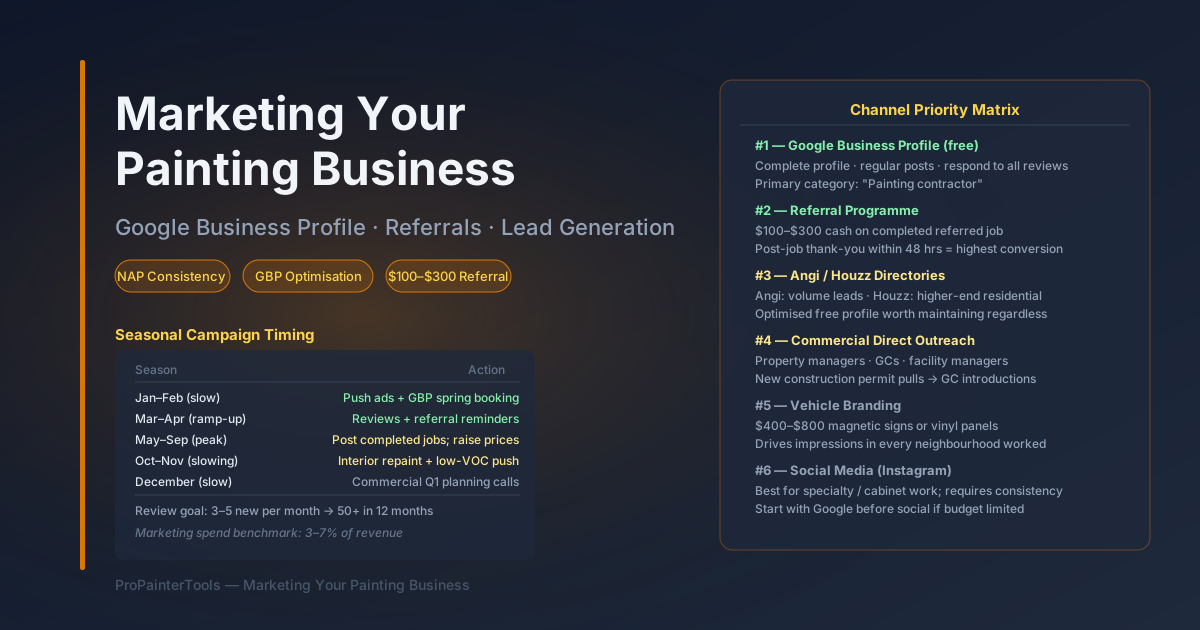
Marketing Your Painting Business: Google, Referrals, and Lead Generation
Painting contractors get most of their revenue from two sources: referrals from past clients and repeat business from the same clients. Everything else — directories, advertising, social media — feeds the pipeline when referrals are insufficient or when you are trying to grow into a new market segment. Understanding which channels are worth the investment for your stage of business, and executing the basics well, is more valuable than elaborate marketing strategies. This guide covers the highest-leverage channels for painting contractors, in order of return on investment.
Google Business Profile (GBP)
Google Business Profile is the single most important online marketing asset for a local painting contractor. When someone in your service area searches "painter near me" or "painting contractor city," the first results they see are Google Maps listings — GBP. This is free, but it requires active management.
Setting Up and Completing Your Profile
A complete profile outperforms an incomplete one in local search. Every field matters:
- Business name: Use your legal trading name exactly — do not keyword-stuff (e.g., "Bob's Painting — Best Painters in Phoenix" is against GBP policy and can get your listing suspended)
- Primary category: Select "Painting contractor" — this is the most important category
- Additional categories: Add "Interior painter," "Exterior painter," and any specialty categories that apply
- Service area: List all zip codes or cities you serve — do not list areas you will not travel to
- Business hours: Keep updated. A closed listing with wrong hours frustrates clients and hurts ranking
- Phone and website: Consistent with your website and other directories (see NAP consistency below)
- Photos: See photo guidance below
- Services: List all services with descriptions — GBP uses this for keyword matching
- Q&A: Seed your own Q&A section with common questions and answers
NAP Consistency
NAP stands for Name, Address, Phone — the three pieces of information used by Google to verify that directory listings refer to the same business. Inconsistency in NAP across directories (Yelp, Angi, BBB, Yellow Pages, your website) confuses Google's verification algorithm and suppresses local search ranking.
Action: Audit your business name, address, and phone number on every directory where your business appears. Correct inconsistencies — even minor ones (Street vs St, Suite vs Ste) affect matching algorithms. Use a single canonical form everywhere.
Review Strategy
Google reviews are the primary ranking and conversion factor for GBP. A profile with 50 reviews at 4.8 stars significantly outperforms one with 10 reviews at 5.0 stars — volume and recency matter, not just score.
Requesting reviews:
- Ask immediately after job completion — the client's satisfaction is highest and the experience is fresh
- Send a direct link to your review page via text (not email — text gets read immediately). The link format is your GBP profile link with
/reviewappended — your GBP dashboard shows the direct review link - Frame the ask as a favour: "If you were happy with the job, it would mean a lot to us if you left a Google review — it takes about 30 seconds and helps our business more than anything else"
Responding to reviews:
- Respond to every review — positive and negative. Thank clients by name for positive reviews. Respond professionally and solution-focused to negative reviews (do not argue). Responses are read by future clients.
Review goal: Target 3–5 new reviews per month consistently. This compounds — 50+ reviews within 12 months puts you near the top of local listings in most markets.
GBP Posts
Use the GBP Posts feature to publish short updates — completed project photos, seasonal offers, and service announcements. Posts appear in your GBP listing and in some search results. Post at least once per month to signal an active business.
Referral Programme
Referrals from existing clients are the highest-quality leads in any painting business — they convert at higher rates and at higher margins because trust is pre-established. A structured referral programme amplifies what most contractors already receive passively.
Programme structure:
- Incentive: A cash reward ($100–$300 depending on job size) paid to the referring client when the referred job is completed and invoiced. Some contractors offer a discount on the referrer's next job instead of cash. Cash is more motivating for most residential clients.
- Communication: Mention the programme at job completion: "We grow through referrals — if you know anyone who needs painting done, we'd love the introduction. We give $X as a thank-you when they complete a job."
- Follow-up: Send a reminder in the post-job thank-you (see below).
- Tracking: Record each referral source — who referred whom, whether the referred job was won, and whether the incentive was paid.
The post-job thank-you: Within 48 hours of job completion, send a short personalised message (text or email) thanking the client by name, referencing the specific project, and including the review link and referral programme mention. This single touchpoint converts satisfied clients into advocates more reliably than any other single action.
Angi and Houzz
Angi (formerly Angie's List) and Houzz are the two primary directory and marketplace platforms for residential painting contractors.
Angi: Angi connects homeowners with contractors through both a directory (where reviews and credentials are visible) and a lead marketplace (where you pay per lead or per job). The paid lead system has variable quality — some contractors find it cost-effective for filling pipeline in slow periods; others find leads too price-sensitive to produce acceptable margin. A free optimised profile with strong reviews is worth maintaining regardless of whether you pay for leads.
Houzz: Stronger for higher-end residential work and clients who are actively engaged in home renovation. A complete Houzz profile with quality project photos positioned toward upscale finishes, cabinet work, or specialty applications attracts a different buyer profile than Angi. Free to set up; Houzz Pro is paid.
What to post on directories: For both, the profile quality matters. Prioritise:
- High-quality project photos (see portfolio section)
- Complete service list
- Current licence and insurance verification
- Response rate — respond to every inquiry within 2 hours during business hours
Residential vs Commercial Marketing Channels
The marketing approach for residential and commercial work differs significantly.
Residential Marketing
Residential clients find painters primarily through:
- Google search (GBP + organic) — highest volume
- Referral from neighbours, friends, or family
- Seeing your vehicle branded in the neighbourhood
Vehicle branding: A professionally lettered truck or van drives impressions in every neighbourhood you work in. The cost is modest ($400–$800 for magnetic signs or vinyl wrap panels); the cumulative impression value over years of driving the same markets is significant.
Neighbourhood seeding: When you finish a job, knock on a few adjacent doors with a brief introduction: "We just finished a project next door for neighbour — if you're ever considering having your home painted, here's our card." The conversion rate is low, but the cost is effectively zero.
Commercial Marketing
Commercial clients — property managers, building owners, facility managers — are not searching Google in the same way residential clients are. They buy from relationships and track records.
Direct outreach: Identify property management companies, commercial real estate firms, and facility management companies in your area. Call them directly, introduce your business, and ask who handles painting decisions. Follow up with a simple capability statement (one-page overview of your commercial experience, insurance limits, references).
New construction permit pulls: Building permit data is public record in most jurisdictions. New commercial construction permits identify general contractors who will need subcontractors — including painters. Monitor permit filings (available through your local building department or a service like BuildingConnected) and introduce your business to GCs during the design phase, before they have committed subcontractors.
Repeat commercial relationships: A facility manager who trusts you with their first building will give you their portfolio. One good commercial relationship can be worth ten residential jobs per year. Prioritise retention of commercial clients above acquisition.
Seasonal Campaign Timing
Most residential painting markets follow a seasonal pattern. Marketing investment should lead the demand curve, not follow it.
| Season | Market Condition | Marketing Action |
|---|---|---|
| January–February | Slow — clients planning | Push Google ads and GBP posts promoting spring booking |
| March–April | Ramp-up — booking season | Increase review requests; referral programme reminders to past clients |
| May–September | Peak — full schedule | Let referrals work; post completed job photos to GBP; raise prices if booked out |
| October–November | Slowing | Target interior repaint campaigns; promote occupied-space low-VOC products |
| December | Slow | Follow-up calls to commercial clients for Q1 planning |
Email list: Build an email list of past clients. A single email in February ("We're booking spring exterior work — reply to get on the schedule") to 200 past clients will generate bookings. The cost is trivial; the return is direct.
For building a portfolio to support your marketing, see our portfolio guide. For converting enquiries into signed contracts, see our contract templates guide.
ProPainterTools generates professional quotes and invoices that reinforce your brand credibility with every client interaction — the quality of your documentation is part of your marketing.
Frequently Asked Questions
How much should a painting contractor spend on marketing? A general benchmark is 3–7% of revenue, but for a growing business, 8–12% is reasonable when investing in paid channels. The floor is the cost of maintaining your GBP, reviews, and basic directory presence — approximately $0 in hard cost but several hours per month in time. Beyond that, paid spend should be benchmarked against cost per acquired customer.
Do Facebook and Instagram ads work for painting contractors? They can, particularly for higher-end residential and specialty work (cabinet refinishing, decorative painting) where visual content creates desire. Instagram is more effective than Facebook for reaching homeowners with discretionary renovation budgets. Both require consistent content investment over 3–6 months before ROI is clear. Start with Google before social if budget is limited.
How long does it take for GBP to show results? A new or optimised GBP profile typically begins improving in local search ranking within 3–6 months of consistent optimisation (complete profile, regular posts, new reviews). In less competitive markets, results can be faster. GBP ranking is cumulative — the profile you build over 2 years outperforms a new competitor's profile in the same period.
Should I respond to negative reviews? Always. A professional, empathetic response to a negative review reassures future clients that you take quality seriously. A defensive or argumentative response to a negative review is more damaging than the review itself. Respond within 24 hours, acknowledge the concern, describe what you did or will do to address it, and offer to continue the conversation offline.
