Historic Building Painting — Preservation Standards, Lead Paint, and Breathable Finishes
24 April 2026 · ProPainterTools
Historic Building Painting: Preservation Standards, Lead Paint, and Breathable Finishes
Historic building painting is a specialised service line that intersects with federal preservation law, lead paint regulations, building science, and materials chemistry. Contractors who develop competence in this area access clients — historic preservation societies, building owners seeking historic tax credits, state historic preservation offices — who pay premium rates for technically appropriate work and who are not primarily motivated by lowest cost. This guide covers the technical and regulatory framework for painting work on historic structures.
The Secretary of the Interior's Standards
The Secretary of the Interior's Standards for the Treatment of Historic Properties (the Standards) are the national reference framework for work on historic structures in the United States. They define four treatment approaches:
- Preservation: Maintaining and repairing existing historic materials — minimal intervention
- Rehabilitation: Repairing and adapting historic structures for continued or new use, while retaining significant historic character
- Restoration: Returning the structure to its appearance at a specific period in history
- Reconstruction: Recreating vanished or non-surviving portions of a historic property
For painting contractors, Rehabilitation is the most common treatment. Standard 6 of the Rehabilitation Standards states: "Deteriorated historic features shall be repaired rather than replaced." Standard 9 adds: "New additions, exterior alterations, or related new construction shall not destroy historic materials that characterise the property."
The practical implication for painting work:
- Identify original paint system before specifying or applying coatings
- Use compatible materials — modern acrylic coatings over original oil-based paint systems can trap moisture; breathable finishes are required on masonry and many wood assemblies
- Avoid aggressive surface preparation methods (wire brushing to bare metal on historic iron work, sandblasting soft masonry) that remove or damage historic material
- Document all work — particularly surface preparation and product selection — for the project record
When the Standards apply: Any project receiving federal historic tax credits, state historic tax credits, federal grant funding, or work on properties listed on the National Register of Historic Places is subject to the Standards. Work on non-listed historic properties without financial incentives is not legally required to follow the Standards, but they remain best practice guidance.
Lead Paint: RRP Overlap and Encapsulation
Pre-1978 buildings — the entire universe of genuinely historic structures — contain lead-based paint. The EPA RRP Rule (Renovation, Repair, and Painting Rule) applies to work in residences and child-occupied facilities; for commercial historic structures, OSHA Lead Standard (29 CFR 1926.62) governs lead exposure.
The key difference: The RRP Rule focuses on minimising dust exposure to building occupants (client-protective regulation). The OSHA Lead Standard focuses on protecting the contractor's workers (worker-protective regulation). Both may apply simultaneously on residential historic work.
Lead Paint Assessment
Before specifying a surface preparation method or coating system, determine the lead paint status:
Option 1 — Assume lead is present: On any pre-1978 building, proceed as if lead-based paint is present in all painted surfaces. Apply lead-safe work practices under the RRP Rule.
Option 2 — Conduct lead paint testing: A Certified Lead Inspector or Risk Assessor tests surfaces using XRF (X-ray fluorescence) or paint chip sampling. Surfaces testing negative for lead are exempt from RRP requirements. Documentation is retained for the project record.
Option 3 — Certified Lead Abatement Contractor: For projects requiring removal of extensive lead paint, a certified lead abatement contractor (separate certification from RRP) may be required under state law. Confirm state requirements for the jurisdiction.
Encapsulation vs Removal
The Standards generally favour encapsulation of lead paint (covering it with an approved encapsulant) over removal, because removal methods can damage historic substrate materials. The EPA has approved specific encapsulation products that are tested for durability and adhesion over lead paint — these are distinct from standard paint products.
Encapsulation requirements: The encapsulant must achieve adhesion of ≥0.5 MPa by ASTM D4541 pull-off test over the existing paint system. Document the product and test results. Standard architectural paints applied over lead paint are not considered approved encapsulants for regulatory purposes — a specifically tested and EPA-listed encapsulant product is required.
RRP lead-safe work practices for historic wood: Wet scraping and low-heat (<180°C) heat guns are permitted. Open-flame burning, power sanding without HEPA vacuum, and rotary wire brushing without vacuum attachment are prohibited. HEPA vacuum on all power tools generating dust is mandatory.
Original Paint System Compatibility
Historic buildings were coated with oil-based paint systems throughout most of American building history. The shift to latex (acrylic) coatings occurred in the 1950s–1970s. Many historic buildings have 10–20+ layers of oil-based paint representing a century of maintenance.
The compatibility problem: Modern water-borne acrylic coatings are more vapour-permeable than the oil paint layers beneath them in some conditions, but form a more impermeable film in others. The critical risk is moisture trapping — if moisture enters the wood or masonry substrate and cannot escape through the coating, it builds pressure beneath the coating and causes delamination. Oil paint systems, which are moderately vapour-permeable, often allow moisture to move through the system without creating this pressure differential.
Diagnosis before specification:
- Conduct pull-off adhesion testing on existing paint to confirm the historic system is still well-adhered
- Assess moisture content of wood (≤15% target before coating)
- Assess moisture source (if substrate is continually wet from failing gutters or grade drainage, painting is not the solution)
Compatible coating choices for historic wood:
- Oil-based paint (alkyd or natural oil): Directly compatible with existing oil-based systems; maintains the original vapour profile. Higher VOC; longer dry time. Some jurisdictions restrict high-VOC oil-based architectural coatings.
- Waterborne alkyd: Modern waterborne formula with alkyd curing chemistry. Low VOC; compatible performance profile to traditional alkyd. Good adhesion over existing oil systems.
- Exterior 100% acrylic over prepared oil system: Acceptable when the existing oil paint is sound and de-chalked, the surface is clean and dry, and a bonding primer is used. Adhesion testing required.
Breathable Finishes for Historic Masonry
Historic masonry — brick, stone, stucco — requires coatings with high moisture vapour permeability (breathability). Masonry buildings manage moisture by allowing vapour to move through the wall assembly and evaporate at the exterior surface. Sealing the exterior surface with a low-permeability coating forces moisture to find another path — typically through the interior, or by building pressure that spalls the masonry face.
Permeability measurement (Perm rating): Materials are rated in perms (grain of water vapour per hour per square foot per inch of mercury pressure). Higher perms = more breathable.
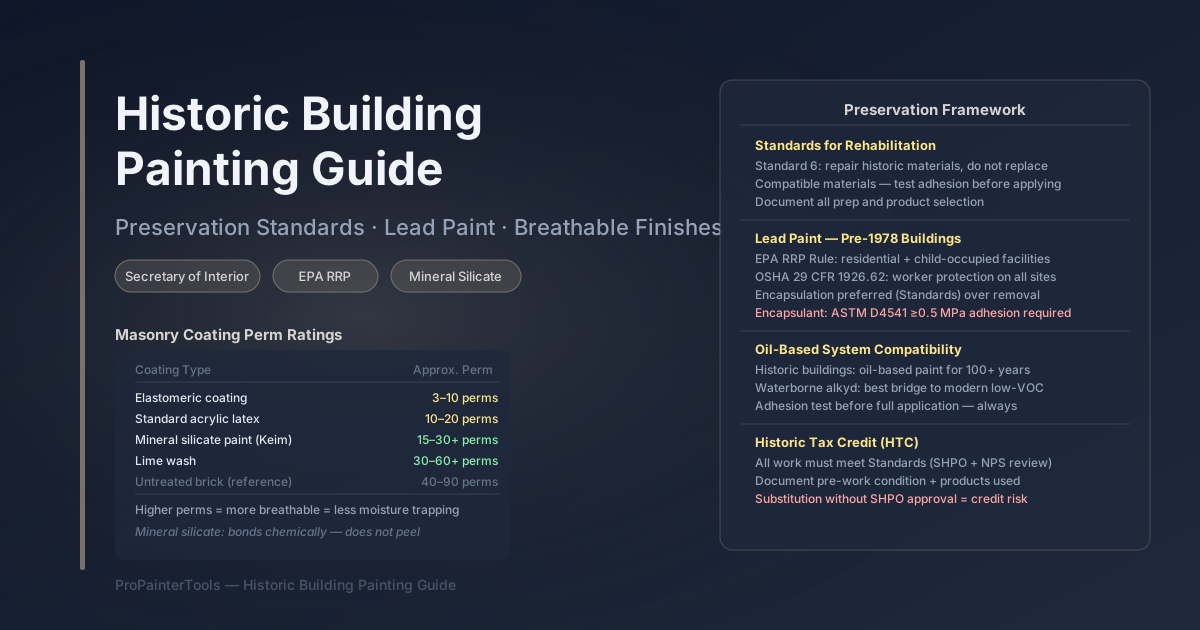
| Coating Type | Approximate Perm Rating |
|---|---|
| Elastomeric coating | 3–10 perms (variable) |
| Standard acrylic latex | 10–20 perms |
| Mineral silicate paint (Keim) | 15–30+ perms |
| Lime wash | 30–60+ perms |
| Untreated brick (for comparison) | 40–90 perms |
Preferred finishes for historic masonry:
Mineral silicate paint (potassium silicate): The gold standard for breathable masonry finish. Binds chemically with siliceous masonry (brick, stone, most stucco) rather than forming a surface film. Does not peel. Extremely vapour-permeable. UV stable. Approved by the Society for the Protection of Ancient Buildings. Requires specific application technique (misting substrate before application; multiple thin coats). Higher material cost than conventional coatings.
Lime wash: Traditional binder of slaked lime (calcium hydroxide) with natural pigments. Highly breathable. Self-healing to hairline cracks. Requires multiple coats. Does not produce the uniform opaque coverage of modern architectural coatings — a chalky, textural appearance is characteristic and appropriate for genuinely historic structures. Incompatible with modern acrylic sealers applied over it.
Conventional exterior acrylic: Acceptable only on masonry with no moisture management issues and where preserving historic character is not a regulatory requirement.
Reversible Treatments
The preservation principle of reversibility holds that treatments applied to historic structures should be removable without damaging the original material. This is most relevant to finishes and coatings.
Lime wash is inherently reversible — it can be removed by washing without damaging the masonry substrate.
Mineral silicate paint bonds chemically with the substrate and is not considered fully reversible, but because it does not form a surface film, it does not create the same pressure failure mode as conventional coatings.
Conventional acrylic coatings are not considered reversible — removal requires aggressive methods (pressure washing, chemical strippers) that can damage historic masonry. Avoid on surfaces where the regulatory context requires reversibility.
Historic Tax Credit Documentation
The federal Historic Tax Credit (HTC) programme (20% credit for qualified rehabilitation of income-producing historic properties) requires that all rehabilitation work meet the Secretary of the Interior's Standards as reviewed and approved by the State Historic Preservation Office (SHPO) and the National Park Service.
What painting contractors may need to document:
- Pre-work condition photographs showing paint failure, substrate condition, and historic features
- Product data sheets for all coatings applied — confirming vapour permeability, adhesion, and compatibility with historic substrate
- Lead paint testing or management documentation
- Post-work photographs confirming completion consistent with the approved scope
Important: Work that does not meet the Standards can result in disqualification of the tax credit — which the building owner discovers after the project is complete. Contractors working on HTC projects should confirm that the paint specifications have been reviewed and approved by the SHPO before applying any product. Do not substitute products without written SHPO approval.
For the lead paint safety protocols and EPA RRP certification requirements that apply to all pre-1978 building work, see our lead paint safety and RRP guide. For surface preparation standards that apply to historic substrates, see our surface preparation standards guide.
ProPainterTools tracks project documentation — photos, product data, compliance records — per job, which is the record-keeping system that historic tax credit projects require.
Frequently Asked Questions
How do I know if a building is a historic property subject to the Standards? Check the National Register of Historic Places (nps.gov/nr) to determine if the property is individually listed or in a listed historic district. Contact the State Historic Preservation Office to confirm. Properties in local historic districts may be subject to local preservation requirements even if not nationally listed — check with the local building or planning department.
Can I use a chemical paint stripper on a historic building? Yes, but carefully. Alkaline strippers (sodium hydroxide) are generally acceptable on wood with thorough neutralisation and rinsing. They should not be used on historic masonry — they can leach into the stone or brick, cause efflorescence, and damage lime mortars. Citrus-based or biodegradable methylene chloride alternatives are gentler. Never use sandblasting on historic soft masonry — it permanently erodes the surface and is specifically prohibited by the Standards.
Is waterborne alkyd compatible with existing lead paint systems? Yes — waterborne alkyd adheres well over existing oil-based paint systems when the surface is properly cleaned and de-chalked. It is one of the best bridges between historic oil systems and modern low-VOC products. Perform adhesion testing before full application on any project where the existing system is unknown or heavy.
What is the difference between lead encapsulation and lead abatement? Encapsulation covers lead-based paint with an EPA-approved encapsulant — the lead remains in place, covered. Abatement removes the lead paint by scraping, chemical stripping, or media blasting to bare substrate, then disposes of it as hazardous waste. Abatement requires a separate certified contractor in most states. Encapsulation is the approach preferred under the Secretary of the Interior's Standards for historic substrates because it minimises damage to original material.
