Masonry and Concrete Surface Preparation for Painters — Acid Etch, CSP Profiles, and Efflorescence
20 February 2026 · ProPainterTools
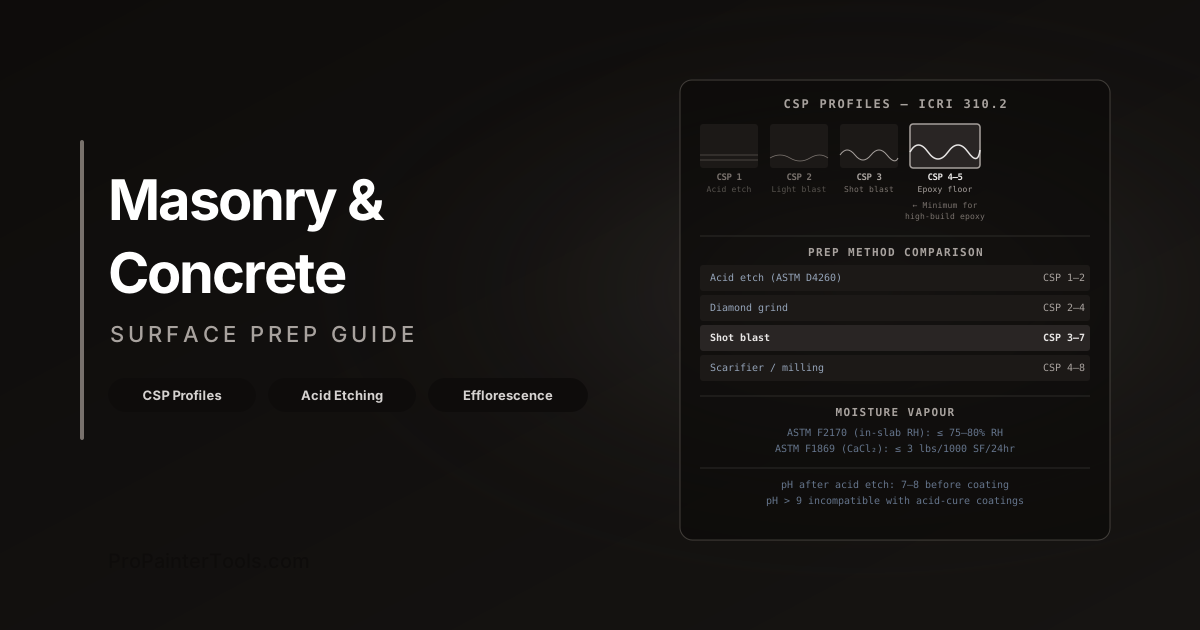
Masonry and Concrete Surface Preparation for Painters: Acid Etch, CSP Profiles, and Efflorescence
Masonry and concrete are among the most demanding substrates in the painting trade. They are alkaline, porous, subject to moisture vapour pressure from below, and arrive on site with contamination — form release agents, curing compounds, laitance, and efflorescence — that is invisible but lethal to coating adhesion. The contractor who primes concrete the same day it's cleaned and calls it done is setting up a callback. The contractor who assesses the substrate, profiles the surface correctly, and tests conditions before coating is setting up a durable system. This guide covers the full preparation workflow for masonry and concrete, from contamination assessment to moisture vapour testing.
The Difference Between Masonry and Concrete Preparation
Brick and block masonry: The primary concerns are efflorescence (soluble salts migrating to the surface), mortar joint condition, existing sealer or paint type, and alkalinity. Brick surfaces rarely need mechanical abrasion unless the substrate is very smooth (slump block, burnished block).
Poured and trowelled concrete: The primary concerns are laitance (the weak surface layer of cement paste and fines), curing compounds and form release agents, and surface profile (CSP) — which must be mechanical for most coating systems. Concrete rarely profiles adequately from acid etch alone for high-build coatings.
Concrete masonry units (CMU/block): Combines concerns from both — porous surface that may have been sealed, mortar joints, alkalinity, and potential for moisture vapour.
Contamination Assessment
Before any cleaning, identify what is on the surface:
Laitance: The weak, chalky layer on trowelled concrete surfaces. Scrape with a coin or nail — laitance scrapes away easily. Must be fully removed before any coating.
Form release agents: Applied to formwork before pouring; remain on the concrete surface after form removal. Can be oil-based or water-based. Conduct a water-bead test: if water beads, a release agent or sealer is present and must be removed.
Curing compounds: Applied to fresh concrete to retain moisture during curing. Most are incompatible with coatings — they must be removed by mechanical means (grinding, shot blasting) or allowed to degrade (typically 28 days minimum before coating).
Existing sealer or paint: Adhesion testing (cross-hatch per ASTM D3359) is required before recoating any masonry with existing coating. See our adhesion testing guide for the full procedure.
Grease and oil: Common on garage floors and workshop slabs. Degrease with a commercial degreaser, rinse thoroughly, and confirm with the water-bead test before proceeding. Acid etching does not remove oil — degrease first.
Efflorescence Treatment
Efflorescence is the white crystalline deposit that appears on masonry surfaces when soluble salts dissolved in water migrate to the surface and crystallise as the water evaporates. It is a symptom of moisture movement through the substrate.
Why it must be removed before coating: Efflorescence forms between the substrate and any coating applied over it, breaking the adhesion bond. Painting over efflorescence locks it in temporarily; it reforms under the new coating and causes delamination within months.
Treatment procedure:
- Dry-brush all visible efflorescence with a stiff brush — this removes loose crystals that have not re-bonded
- Wet the surface thoroughly (prevents acid from over-penetrating)
- Apply a dilute muriatic acid solution (hydrochloric acid, 1:10 to 1:4 in water — start dilute and increase if needed). Use a plastic brush or sprayer; never metal
- Allow to react for 3–5 minutes — mild effervescence indicates the acid is working
- Scrub with a stiff brush
- Neutralise with a solution of baking soda and water (1 cup per gallon)
- Rinse thoroughly until runoff is clear and there is no acid odour
Safety: Always add acid to water, never the reverse. Muriatic acid fumes are corrosive — work with ventilation, eye protection, acid-resistant gloves, and respiratory protection. Dispose of spent acid solution per local regulations.
Recurrence: Efflorescence that reappears after treatment indicates ongoing moisture movement. Painting will not stop it. The moisture source must be addressed (drainage, waterproofing, pointing) before a durable coating system can be applied.
Acid Etching (ASTM D4260)
Acid etching is the most common chemical method for preparing bare concrete before coating. It removes laitance and creates a light etch profile suitable for thin-film paint systems.
Limitations: Acid etch produces a CSP 1–2 surface profile (see table below). This is adequate for thin architectural coatings but insufficient for high-build epoxy systems, polyurethane, or any product that requires CSP 3 or higher. Do not acid-etch as a substitute for mechanical preparation on industrial floor coating projects.
Procedure (ASTM D4260):
- Degrease and clean the surface first
- Pre-wet the concrete uniformly
- Apply dilute muriatic acid (1:3 to 1:1 in water, depending on concrete hardness) evenly across the surface
- Allow 3–5 minutes of reaction time — the surface should effervesce (bubble) moderately
- Scrub with a stiff broom
- Neutralise with a baking soda solution and rinse
- Allow to dry completely (minimum 24 hours in warm conditions; check moisture vapour before coating)
- Profile should feel like fine sandpaper — if the surface is still smooth, repeat the etch
pH after treatment: Test with pH paper or a pH meter. The surface should read pH 7–8 before coating. Residual alkalinity (pH > 9) is a concern for acid-catalysed coatings (conversion varnish, acid-cure epoxy) — these systems fail in high-alkalinity conditions.
Surface Profile: ICRI CSP Grades
The International Concrete Repair Institute (ICRI) Guideline No. 310.2 defines nine Concrete Surface Profile (CSP) grades based on surface texture, from CSP 1 (lightest) to CSP 9 (most aggressive). The coating manufacturer specifies the minimum CSP required for adhesion.
| CSP Grade | Surface Texture | Typical Preparation Method |
|---|---|---|
| CSP 1 | Very fine — similar to acid-etched | Acid etch, light abrasive blast |
| CSP 2 | Fine — similar to sanded concrete | Acid etch (repeat), scarifier, light shot blast |
| CSP 3 | Light orange peel | Shot blast, angle grinder with flap disc |
| CSP 4 | Moderate orange peel | Shot blast, scarifier |
| CSP 5 | Rough — occasional pinholes | Shot blast (heavier), scabbling |
| CSP 6 | Very rough — pinholes common | Shot blast, heavy scarifier |
| CSP 7–9 | Extreme — aggregate exposed | Scabbling, bush hammer, jack hammer |
Minimum CSP by coating type:
- Thin-film paint (< 3 mils): CSP 1–2
- Standard epoxy floor coating (4–8 mils): CSP 3–4
- High-build epoxy or polyurethane (> 8 mils): CSP 4–5
- Cementitious overlay or topping: CSP 6–9
Mechanical Preparation: Shot Blast vs Scarify vs Diamond Grind
| Method | CSP Achieved | Best Application | Limitations |
|---|---|---|---|
| Shot blast | CSP 3–7 | Large floors, parking structures, industrial | Requires specialist equipment and trained operator |
| Diamond grind | CSP 2–4 | Floor prep where shot blast is not possible; existing coatings | Generates silica dust — requires HEPA vacuum; slower than shot blast |
| Scarifier (milling) | CSP 4–8 | Removing thick coatings, raising high spots | Very aggressive; can leave deep lines if mishandled |
| Angle grinder (flap disc/cup) | CSP 2–4 | Spot preparation, edges, detail areas | Too slow for large areas |
| Hand grinding/wire brush | CSP 1–2 | Spot repairs, edges only | Insufficient for full-surface prep |
Silica exposure: Any dry mechanical concrete preparation generates crystalline silica dust. OSHA 1926.1153 (construction silica standard) requires exposure assessment, engineering controls (HEPA vacuum), respiratory protection (minimum N95), and medical surveillance for regular work. Do not grind concrete dry without a vacuum attachment.
Moisture Vapour Testing
Concrete slabs transmit moisture vapour upward from the ground. Coatings applied over high moisture vapour emission rates will delaminate — water vapour accumulates under the coating, creating blisters and adhesion failure.
ASTM F2170 (in-slab RH probe): The most accurate method. RH probes are embedded 40% into the slab depth and read after a 24-hour equilibration period. Most coatings require ≤ 75–80% RH. Epoxy floor coatings often require ≤ 75% RH.
ASTM F1869 (calcium chloride test): Measures moisture vapour emission rate (MVER) in pounds per 1,000 SF per 24 hours. Maximum for most coatings: 3 lbs/1,000 SF/24hr.
For full moisture testing procedures for both concrete and wood, see our moisture testing guide.
Frequently Asked Questions
Can I apply masonry paint directly over efflorescence if I prime first? No. Primer does not seal in efflorescence — it provides a temporary film over soluble salts that will migrate through and fracture the paint system. Efflorescence must be physically removed and the source of moisture addressed before any coating is applied.
How long after new concrete is poured can I paint it? Minimum 28 days for the concrete to reach design strength and for pH to drop from the initial > 13 (fresh concrete) to a coatable level. Some fast-cure systems allow earlier application, but always test pH before proceeding. New concrete may also require removal of curing compounds before coating.
Is acid etching adequate for an epoxy garage floor system? Only for thin-film systems. Most broadcast chip epoxy systems or high-build epoxies require CSP 3 minimum, which acid etching alone cannot reliably achieve on dense, trowelled concrete. Shot blasting or diamond grinding to CSP 3 is the professional standard for epoxy floor applications.
What is the difference between alkalinity and efflorescence? Alkalinity is the pH of the substrate itself (concrete is naturally pH 12–13 when new, dropping to pH 8–9 when carbonated). Efflorescence is a specific phenomenon — soluble salts (often calcium carbonate) migrating to the surface. Alkalinity affects acid-cure coating systems; efflorescence breaks coating adhesion physically. Both must be assessed separately.
