Scaffolding and Access Equipment Guide for Painting Contractors
11 April 2026 · ProPainterTools
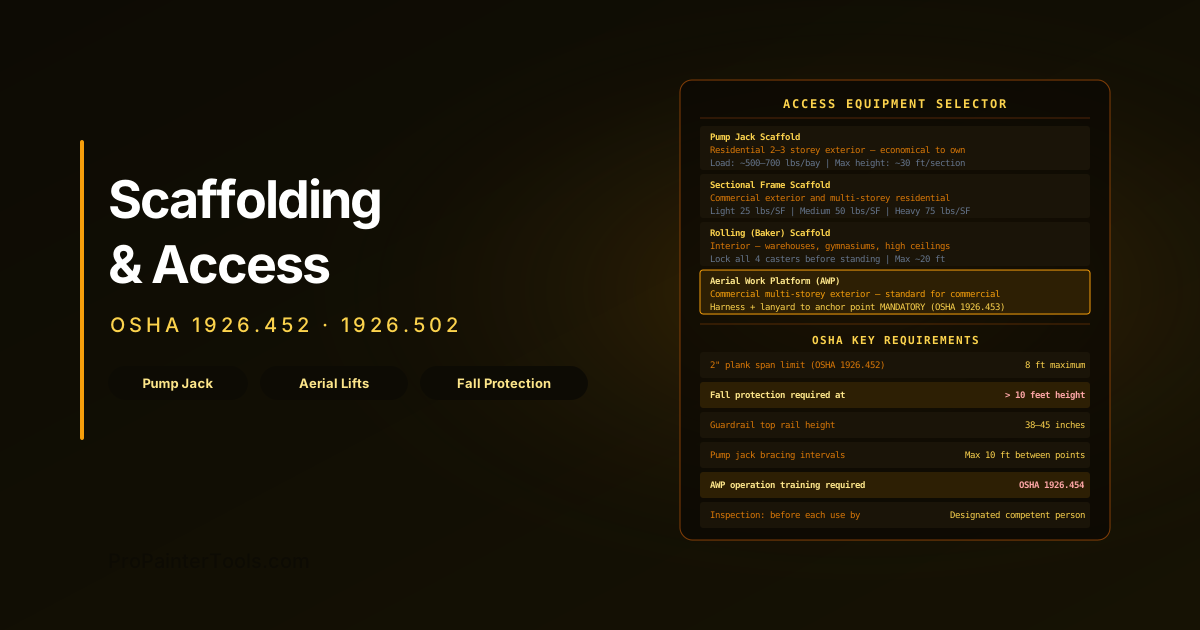
Scaffolding and Access Equipment Guide for Painting Contractors
Access equipment is one of the most significant safety decisions a painting contractor makes on any multi-storey project. Falls from height are the leading cause of fatality in the construction industry, and painting contractors spend more time at height than almost any other trade. Understanding the options, their load ratings, the OSHA regulations that govern them, and when to own versus rent each type is essential knowledge for running a professional painting operation.
Overview of Access Equipment Types
Pump Jack Scaffold
A pump jack system uses vertical poles (wood or aluminium) attached to the building and a platform bracket that travels up and down the pole using a foot-operated ratchet mechanism. The painter pumps the jack up with one foot while standing on the platform.
Best for: Residential exterior painting on two- and three-storey structures. Economical to own; minimal setup time on standard residential buildings. Provides excellent reach across long facade sections.
Load capacity: Most aluminium pump jack systems are rated for two workers plus 250 lbs of material per bay, approximately 500–700 lbs total distributed load. Never exceed the rated load — check the manufacturer's label on the bracket.
Limitations:
- Requires a solid attachment point on the building (typically blocked at the top of the wall)
- Not suitable for buildings without a working surface to attach the top pole bracket
- Not appropriate for commercial or industrial structures; not OSHA-approved for heavy construction use
- Pole length typically maxes out at approximately 30 ft per section (extendable with couplers)
OSHA: OSHA 29 CFR 1926.452(o) covers pump jack scaffolds. Key requirements: poles must be braced against the structure; the maximum vertical distance between bracing points is 10 feet; only authorised workers may use the scaffold.
Sectional Frame Scaffold
The traditional tubular frame scaffold system used across residential and commercial painting. Steel or aluminium frames (typically 5 ft wide × 5 ft or 6.5 ft high) stacked vertically with cross braces and decked with wood planks or manufactured aluminium decking.
Best for: Commercial exterior and multi-storey residential where a stable work platform is needed across a large area. Adaptable to almost any building shape.
Load capacity:
- Light duty (painters' scaffold): 25 lbs/SF
- Medium duty: 50 lbs/SF
- Heavy duty: 75 lbs/SF
Painting applications typically require medium duty (50 lbs/SF) at a minimum. Mark the scaffold with a load rating tag visible to workers on the platform.
Plank span limits (OSHA 1926.452, Table):
| Plank thickness | Maximum span |
|---|---|
| 2" nominal scaffold plank | 8 ft |
| Laminated veneer lumber (LVL) plank | Per manufacturer rating |
| Aluminium decking | Per manufacturer rating |
Fall protection: At heights above 10 feet, OSHA 1926.502 requires guardrail systems (top rail 38–45 inches height, mid-rail at the midpoint) or personal fall arrest systems. A toeboard is required at the platform edge where tools or materials could roll off.
Rolling (Baker) Scaffold
A freestanding tubular scaffold on casters, used for interior work — painting high walls and ceilings in commercial buildings, warehouses, gymnasiums, and large interior spaces.
Best for: Interior painting at 10–20 ft. Fast to move; no wall attachment required.
Key rules:
- Lock all four casters before standing on the platform
- Never ride a rolling scaffold while it is moving
- The base width must be a minimum of 1/3 the working height — wider bases for taller configurations
- Maximum platform height is 20 ft for a standard baker scaffold without additional engineering
OSHA: OSHA 29 CFR 1926.452(p). Outriggers may be required at higher configurations to maintain the width-to-height ratio.
Aerial Work Platforms (AWPs)
Aerial lifts — scissor lifts and boom lifts — are the standard access equipment for commercial painting on multi-storey facades, large interior spaces, and industrial structures.
Scissor lift: Vertical travel only. Excellent for flat facades, ceiling work in warehouses, and retail interior. Electric models for indoor use; diesel for outdoor.
Boom lift (articulating or telescoping): Provides outreach as well as height. Articulating boom allows the operator to reach over obstructions. Telescoping boom provides maximum horizontal reach. Boom lifts are the standard for multi-storey commercial exterior work.
Capacity: Most rental AWPs are rated for 500–1,000 lbs platform capacity. Painting crew plus equipment plus material must be within the rated capacity.
OSHA: OSHA 29 CFR 1926.453 governs aerial lifts. Key requirements: workers must wear a body harness and lanyard connected to the designated anchor point in the basket. The lanyard must be of the type specified for the lift — positioning lanyards only, no shock-absorbing lanyards that could allow the worker to swing outside the basket.
Licence / certification: Aerial lift operation requires documented training under OSHA 1926.454. The training must be job-site specific (the lift type being used). A certificate card alone does not satisfy OSHA if the worker has not been trained on the specific model.
Rental vs own: For most painting contractors, renting aerial lifts is the standard approach. Daily rental for a scissor lift runs $200–$400; a boom lift $350–$800. Purchase is justified only for contractors doing sustained commercial work at height where the utilisation rate justifies capital investment.
Swing Stage (Suspended Scaffold)
A swing stage is a suspended platform lowered from the building roof on wire ropes, used for high-rise building painting and maintenance. This is a specialised scope requiring engineering certification, rigger training, and specific equipment certification.
OSHA: OSHA 29 CFR 1926.452(u)–(v). Two independent wire ropes per suspension point. Outrigger beams require engineering sign-off. Workers must have specific suspended scaffold training and use a separate personal fall arrest system (not reliant on the scaffold suspension lines).
Contractor note: Swing stage work is a specialised niche. Do not take on swing stage painting work without proper equipment, certified riggers, and appropriate insurance coverage. The liability exposure from an unsupported swing stage failure is severe.
Pre-Use Inspection Checklist
Before using any scaffold system, the competent person designated by OSHA must complete an inspection. Key items for painting contractors:
Frame scaffold:
- All frames plumb and level; base plates and mud sills on firm footing
- All cross braces connected at both ends
- Decking planks in good condition; no splits, knots through the cross-section, or rot
- Decking planks extended minimum 6 inches past the support; lapped minimum 12 inches if not end-to-end
- Guardrails installed at all open sides above 10 feet
- Access ladder or stairway present; no climbing cross braces
- Load capacity posting visible
Pump jack:
- Pole brackets securely fastened to the building at the required intervals
- Platform brackets in good condition; ratchet mechanism functioning
- No bent or damaged pole sections
- Safety device engaged (secondary bracket preventing fall if primary fails)
Aerial lift:
- Pre-operation inspection per manufacturer checklist (typically a walk-around inspection form)
- All controls functioning at ground level before elevating
- Tyre pressure and structural damage check
- Harness and lanyard in good condition; anchor point identified
Rent vs Own Decision
| Equipment | Own if | Rent if |
|---|---|---|
| Pump jack system | Primarily residential exterior | Occasional only |
| Frame scaffold | High utilisation (multiple ongoing exterior jobs) | Infrequent commercial work |
| Rolling scaffold | High utilisation (regular commercial interior) | One-off projects |
| Scissor lift | 3+ days per week utilisation year-round | Standard — rent |
| Boom lift | Almost never — very high capital cost | Always rent |
Scaffold ownership requires storage space, regular inspection, and periodic certification. For most painting contractors working across residential and light commercial, renting frame scaffold and aerial lifts is the financially rational choice.
For fall protection equipment (harnesses, lanyards, anchors), PPE respirators, and hearing protection relevant to work at height, see our safety gear and PPE guide. For surface preparation tool selection that often follows scaffold erection on commercial projects, see our surface prep tools guide.
ProPainterTools allows you to include access equipment costs in your project estimates — scaffold rental, lift day rates, and erection labour — ensuring access costs are recovered in every bid.
Frequently Asked Questions
Does every state follow OSHA scaffold regulations? Most states operate their own OSHA-approved state plans (Cal/OSHA, Washington L&I, etc.) which must be at least as strict as federal OSHA. Some state plans are stricter. Always verify with your state's occupational safety agency for any state-specific requirements beyond federal OSHA 29 CFR 1926 Subpart Q (Scaffolds).
Who is the "competent person" required for scaffold inspection? A competent person under OSHA is someone who has been trained and has the authority to identify and correct hazards immediately. On a painting project, this is typically the supervisor, foreman, or owner who has received scaffold safety training. OSHA does not require formal certification for a competent person — documented training and demonstrated knowledge are sufficient.
Can painting workers erect their own scaffold? For frame scaffold and pump jack systems, yes — a competent person must supervise erection. Swing stage and suspended scaffold systems require a qualified person (an engineer or someone with specific technical qualifications) in addition to the competent person. For rental aerial lifts, the contractor is responsible for operation training, not erection.
What is the maximum height for a ladder before scaffold is required? OSHA does not set a specific height at which scaffold becomes mandatory instead of a ladder. The determination is based on the nature of the work — tasks requiring two hands, sustained work at height, or carrying tools and materials are not appropriate for ladder work. Painting contractors should use scaffold or aerial lifts for any work requiring sustained effort above approximately 12–15 feet.
