Paint Rollers and Extension Poles — Nap Selection, Cover Materials, and Frame Quality
13 April 2026 · ProPainterTools
Paint Rollers and Extension Poles: Nap Selection, Cover Materials, and Frame Quality
A roller cover is a consumable, but not all roller covers are equal. The wrong nap thickness leaves too much or too little texture in the finished coat. A cheap cover sheds fibres into the paint film and requires more material per square metre than a quality equivalent. A poorly constructed frame drips, wobbles, and fatigues the painter. These details accumulate across hundreds of production hours — the right equipment is a productivity investment, not an overhead cost. This guide covers the specifications that matter when selecting rollers and extension poles for professional painting work.
Nap Thickness Selection
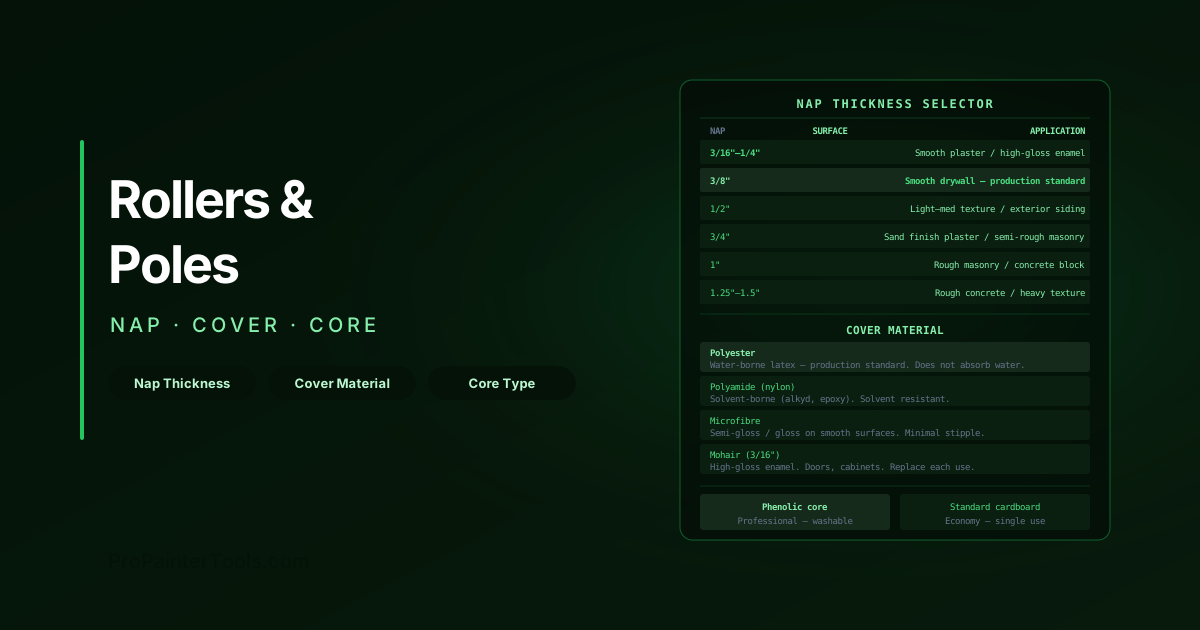
Nap thickness (also called pile height or nap length) determines how much paint the roller holds and how much texture it imparts to the applied film. The correct nap for a given surface is a balance between:
- Paint loading capacity: Thicker nap holds more paint, reducing the number of times you return to the tray
- Texture imparted: Thicker nap produces a more pronounced stipple texture in the wet film
- Levelling quality: Thinner nap produces a smoother film with less stipple
| Nap Thickness | Surface Type | Typical Application |
|---|---|---|
| 3/16" – 1/4" (5–6 mm) | Ultra-smooth surfaces | Smooth plaster, primed drywall, high-gloss enamel on smooth walls |
| 3/8" (10 mm) | Smooth to lightly textured | Smooth drywall, painted timber, most interior flat and satin walls |
| 1/2" (12 mm) | Light to medium texture | Lightly textured drywall, orange peel texture, exterior smooth siding |
| 3/4" (18 mm) | Medium texture | Sand-finish plaster, semi-rough masonry, exterior textured surfaces |
| 1" (25 mm) | Rough texture / masonry | Rough masonry, concrete block (unpainted), split-face block |
| 1.25"–1.5" (30–38 mm) | Rough concrete / heavy texture | Rough poured concrete, heavily textured coatings |
Production rule: For flat and eggshell on standard drywall, 3/8" is the production standard. Using 1/2" nap produces a slightly rougher stipple — acceptable for flat, but visible in low-sheen finishes in raking light. Use 3/8" for satin and semi-gloss on drywall to minimise stipple.
For exterior: 1/2"–3/4" nap is the standard for smooth to moderately textured surfaces. On rough masonry and concrete block, 1" nap ensures material gets into the surface profile without leaving voids.
Roller Cover Materials
The fibre material of the roller cover determines its loading capacity, release characteristics, solvent compatibility, and shedding behaviour.
Polyester
Best for: Water-borne latex paints — interior and exterior.
Characteristics:
- Does not absorb water — maintains consistent nap height during use
- Good paint release, moderate loading capacity
- Compatible with water-borne materials; avoid with solvent-borne (polyester absorbs solvents and softens)
- Low lint — production-grade polyester covers shed minimal fibre into the paint film
- Most economical choice for production latex work
Quality signal: In a cheap polyester cover, the fibres will shed when you drag your finger across them. A quality polyester cover holds its fibres firmly. Roll on cardboard or a test surface before starting — if fibres appear in the roll-out, the cover is not production-grade.
Polyamide (Nylon)
Best for: Solvent-borne coatings (alkyd, oil-based enamel, epoxy primers).
Characteristics:
- Solvent-resistant — does not soften or degrade in contact with mineral spirits, xylene, or MEK
- Good paint release for oil-based products
- More expensive than polyester; not necessary for water-borne work
Note: Nylon covers can also be used with latex but offer no advantage over polyester. Use polyamide specifically where solvent resistance is required.
Microfibre
Best for: Smooth surfaces requiring a very fine finish — high-gloss enamel, semi-gloss trim, high-build primer on smooth drywall.
Characteristics:
- Very fine fibres produce minimal stipple in the applied film — closest to brush finish achievable with a roller
- Excellent for semi-gloss and gloss on smooth surfaces where stipple is undesirable
- Less loading capacity than standard polyester at equivalent nap height
- More expensive; single-use in most production contexts
Lambswool and Mohair
Lambswool: Natural fibre, traditionally used for solvent-borne architectural coatings and primers. Good loading capacity and paint release. Absorbs water and loses loft — not for latex. Becoming less common as synthetic alternatives have improved.
Mohair: Very short nap (3/16"–1/4"), ultra-smooth. Used for high-gloss enamel on perfectly smooth surfaces — doors, cabinetry, high-end trim. Produces the smoothest roller-applied finish achievable. Expensive and delicate — do not wash; replace after each use.
Roller Core Construction
The core is the cylindrical tube around which the cover is wound. Core quality determines how long the cover lasts before the cover separates from the core.
Phenolic (resin-impregnated cardboard): The standard for quality professional covers. Phenolic cores are stiff, dimensionally stable when wet, and resist the solvent penetration that causes standard cardboard cores to delaminate. Covers with phenolic cores last 2–3× longer when washed and reused. Identifiable by the brown or black colour of the core end and the firm feel when squeezed.
Plastic core: Offers the same solvent resistance as phenolic but at a higher cost. Common in premium and specialty covers. Does not absorb water or solvent.
Standard cardboard core: Common in economy covers. Absorbs water and delaminate after 1–2 washes. Acceptable for one-time-use scenarios; not cost-effective for washable reuse in production work.
Roller Frame Construction
The frame holds the cover, connects to the extension pole, and must distribute load without wobble or drip.
Key frame features:
- Cage construction: A quality frame uses a wire cage (typically 5 or 9 wire) that keeps the cover centred and rotating smoothly. A poorly constructed cage causes the cover to wobble, producing an uneven film.
- End cap design: The end caps must seal against the end of the cover without leaking — drips from the end of the roller leave marks on skirting boards and floors. Frames with solid end caps (and a paint-tight seal to the cover) minimise drip.
- Handle thread: The connection between the frame handle and the extension pole is a standard 3/4"-5 threads-per-inch (TPI) thread, used by all professional extension poles. Ensure the frame handle threads are clean and undamaged.
- Bearing: Quality frames have a smooth-rolling bearing between the cage and the spindle. A stiff or gritty bearing increases arm fatigue over a full day of rolling.
Recommended purchase: Buy a quality frame once — Wooster, Purdy, and Shur-Line professional frames are durable and resist the wobble and drip of economy frames. Replace covers as consumables.
Extension Poles
Extension poles allow the painter to reach ceilings, high walls, and floor areas without a ladder or constant repositioning.
Lengths:
- 4–8 ft (fixed or telescoping): Standard for wall and ceiling rolling — most ceilings and walls up to approximately 10–12 ft are reachable with a standing operator.
- 8–16 ft (telescoping): For stairwells, large open spaces, and tall interior volumes.
- Over 16 ft: Heavy and fatiguing — usually better to use a rolling scaffold platform for sustained work at height.
Load rating: Extension poles are rated for load at full extension — typically 15–25 lbs for a standard telescoping pole. A fully loaded 9" roller with paint and frame weighs approximately 3–4 lbs. Operating well within the load limit reduces flex, which causes wobble in the applied film.
Pole materials:
- Aluminium: Lightweight, durable, most common for professional use.
- Fibreglass: Non-conductive — important for work near electrical hazards. Slightly heavier than aluminium.
- Wood (broom-handle): Traditional, inexpensive, adequate for shorter lengths. No telescoping capability.
Connection: The 3/4"-5 TPI thread is universal across professional poles and frames. Thread-on connection is more secure than push-and-lock for sustained overhead work.
Cleaning and Maintenance
Water-borne covers:
- Roll out excess paint into the tray or a scrap surface.
- Rinse under warm water, working paint out of the nap by squeezing with your hands.
- Use a roller spinner to spin out water — this extends cover life significantly by preventing the core from sitting in moisture.
- Store with the nap up or hanging — not resting on a flat surface, which deforms the nap.
Solvent-borne covers:
- Roll out excess paint.
- Wash in the appropriate solvent (mineral spirits for alkyd), working solvent through the nap.
- Follow with a water wash if the solvent is water-miscible; otherwise, solvent-only wash.
- Spin and stand upright to dry.
When to discard: A cover that has lost loft (the fibres are permanently matted flat), is shedding fibres, or has a delaminating core should be discarded. A delaminated cover wobbles on the frame and produces an uneven film.
For matching roller nap to specific coating viscosities and applications, see our pro sprayer guide for the spray-or-roll decision. For production rolling technique in combination with spray application, see our exterior repaint guide.
ProPainterTools lets you log materials and consumables per job — tracking roller cover usage against square metres applied to measure your actual coverage rates and compare against PCA P10 benchmarks.
Frequently Asked Questions
How many square metres should one roller cover handle? A quality 9" polyester cover with phenolic core should cover 700–1,000 m² of standard latex before it needs replacement (assuming proper cleaning after each use). Economy covers last 200–400 m². Production painters who wash covers nightly and replace them after 3–5 days of use are operating within normal parameters.
Is there any difference between a 9" and 4" roller other than size? The same nap and cover material principles apply to both. 4" covers are used for trim, small areas, and cutting-in adjacent to edges where a full-size roller would be too large. The same nap selection rule applies — use 3/8" for smooth trim, 1/2" for textured trim or fence rails.
Does roller cover brand matter? Yes — within the same nominal specification. A Purdy or Wooster 3/8" polyester cover outperforms a no-name equivalent in lint-free application, loading capacity, and durability over multiple washes. The cost difference is recovered in one job through fewer fibres in the finish and faster coverage from better paint loading.
Can I use a roller to apply epoxy floor coating? Yes. Use a 3/8" shed-resistant polyester cover for standard epoxy. Shed-resistant covers have fibres that do not release into the epoxy film. For polyaspartic topcoats, use a low-nap shed-resistant cover (3/8") and maintain a fast application pace to account for the short pot life. See our epoxy floor coatings guide for system-specific application guidance.
