Professional Wood Finishing Systems — Lacquers, Varnishes, and Waterborne Finishes
25 March 2026 · ProPainterTools
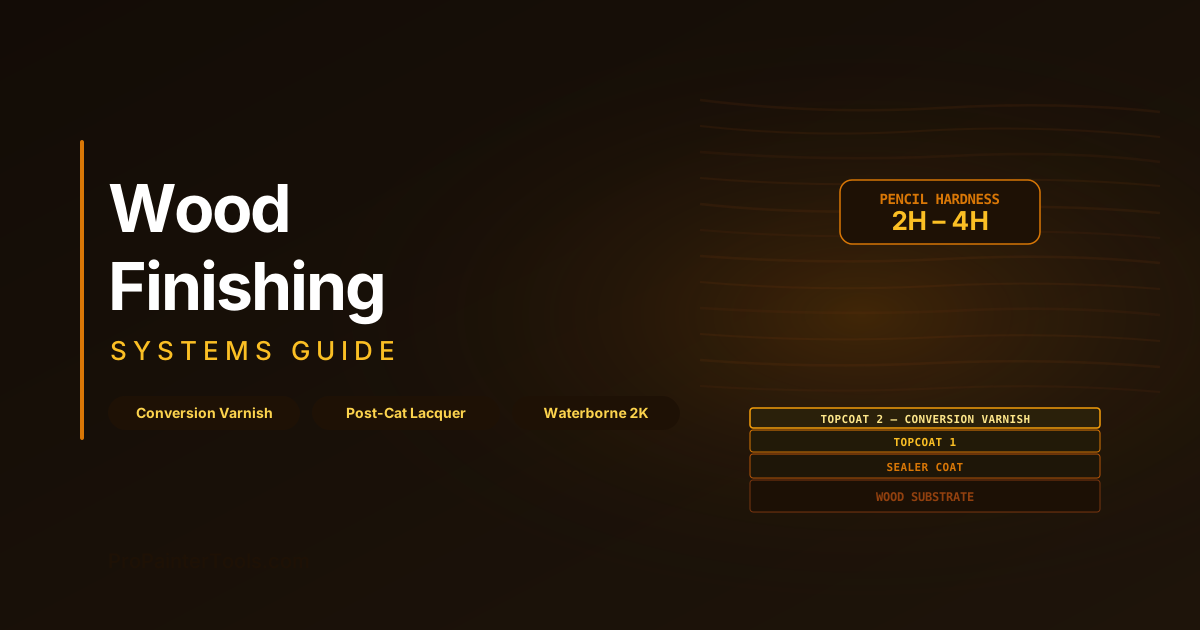
Professional Wood Finishing Systems: Lacquers, Varnishes, and Waterborne Finishes
Professional wood finishing is a distinct discipline within the painting trade — one where resin chemistry, film build, grain control, and sheen consistency determine whether a cabinet shop or high-end residential client gets a decade of service life or a surface that fails at the first exposure to cleaning products. This guide covers the four main categories of professional clear finish systems, their chemistry, performance characteristics, and the substrate conditions required before application.
Film-Forming vs Penetrating Finishes
Wood finishes divide into two fundamental categories:
Film-forming finishes — lacquers, varnishes, polyurethanes, and conversion coatings — sit on the surface of the wood and create a hard protective layer. Film thickness and hardness determine chemical and abrasion resistance.
Penetrating finishes — oils, waxes, and oil/varnish blends — absorb into the wood fibres and cure within the wood rather than on top of it. They provide limited surface protection but excellent grain clarity and are easily repaired by reapplication.
Professional finishing for cabinetry, millwork, and architectural woodwork is almost exclusively film-forming. The remainder of this guide focuses on film-forming systems.
Moisture Content Before Finishing
Before any finish is applied, wood must be at the correct moisture content for the application environment. Finishing over wood with elevated moisture traps water vapour beneath the film, causing blistering, cloudiness (blushing), and adhesion failure as the wood continues to move and dry.
Acceptable moisture content for interior clear finishing:
- Hardwoods (oak, maple, walnut): ≤ 8% MC
- Softwoods used in painted applications: ≤ 12% MC
- MDF and engineered substrates: verify with meter — can retain moisture in the core
Test with a calibrated pin or pin-less moisture meter before proceeding. See our complete moisture testing guide for testing methods, meter types, and species correction factors.
Nitrocellulose Lacquer
Nitrocellulose (NC) lacquer was the dominant professional wood finish for most of the 20th century and remains in use in some production environments. It cures by solvent evaporation only — there is no cross-linking reaction. This means:
- Fast dry time: Touch-dry in 15–30 minutes under ideal conditions
- Easy repair and rework: Subsequent coats of NC lacquer dissolve into and fuse with previous coats (thermoplastic behaviour), allowing easy sanding, repair, and blending
- Low film hardness: The same thermoplastic nature that makes NC easy to repair makes it soft and susceptible to heat, chemicals, solvents, and abrasion
- High VOC content: NC lacquers use aggressive solvent packages (acetone, MEK, toluene) and typically carry 600–800 g/L VOC — non-compliant in many jurisdictions under current architectural coating regulations
Appropriate applications: Musical instrument finishing (where long-term repairability is critical), restoration of antique furniture, low-budget production cabinetry where durability requirements are modest and turnover is fast.
Not appropriate for: Kitchen cabinets, bathroom vanities, commercial millwork, or any surface that will be exposed to cleaning products, standing water, or regular handling.
Post-Catalyzed Lacquer
Post-catalyzed lacquer uses an acid catalyst — typically p-toluenesulfonic acid — to initiate cross-linking in a urea-formaldehyde or melamine-formaldehyde modified alkyd resin. The catalyst is added to the material just before spraying, and the cross-linking reaction proceeds over 24–72 hours at room temperature.
Performance characteristics:
- Significantly harder and more chemically resistant than nitrocellulose lacquer
- Resistant to common household cleaners, mild acids, and alcohols
- Moderate water and heat resistance — not suitable for immersion or temperatures above 60°C
- Recoat window: typically 30–60 minutes between coats, with a maximum overcoat window of 24–48 hours (sanding required after this window)
- VOC content: lower than NC lacquer, typically 250–450 g/L
Catalyst ratio is critical. Over-catalysing causes the finish to cure prematurely, reducing pot life and adhesion. Under-catalysing produces soft, under-cured film that feels tacky weeks later. Always follow the manufacturer's specified catalyst percentage — typically 5–10% by volume — and use a calibrated measuring cup. Estimating by eye is not acceptable.
Typical applications: Production cabinetry, furniture, interior architectural millwork in medium-exposure environments.
Conversion Varnish
Conversion varnish (also called acid-catalysed varnish or CV) is the benchmark professional finish for high-durability kitchen and bathroom cabinetry. An acid catalyst cross-links an alkyd-urea or alkyd-melamine resin system, producing a harder and more chemically resistant film than post-cat lacquer.
Performance characteristics:
- Extremely hard film: pencil hardness 2H–4H when fully cured
- Excellent chemical resistance: resistant to household cleaners, grease, coffee, alcohol, and mild acids
- Good heat resistance: up to 80–100°C for most formulations
- Full cure: 5–7 days at room temperature — parts should not enter service before full cure
Application requirements:
- Spray application only — HVLP, conventional air-assisted, or airless. Conversion varnish cannot be successfully applied by brush or roller.
- Temperature: 15–30°C. Below 15°C the acid-catalysed cure slows significantly and under-cure is likely.
- Grain filling: open-grain hardwoods (oak, ash) require grain filler or multiple sealer coats and thorough sanding to achieve a smooth, level surface before topcoating.
- Maximum build per coat: do not exceed the manufacturer's specified wet film thickness per coat — over-application traps solvents and causes wrinkling or checking.
VOC compliance note: Conversion varnishes typically carry 250–400 g/L VOC. Check your state or regional limits before specifying — some jurisdictions have reduced thresholds that affect solvent-borne CV formulations.
Typical applications: Kitchen cabinet doors, bathroom vanities, reception desk faces, high-end retail millwork, commercial restaurant furniture.
Waterborne Wood Finishes
Waterborne clear finishes have advanced significantly over the past decade and now offer performance competitive with many solvent-borne systems while delivering dramatically lower VOC content (typically 50–150 g/L) and compliance with the strictest regulations.
Waterborne Polyurethane
Waterborne polyurethane uses an aliphatic polyurethane dispersion in water. It offers good hardness, excellent UV stability, and a clear water-white appearance — the milky-white colour in the can converts to clear on drying and does not add the warm amber tone of oil-based finishes.
Advantages:
- No yellowing — wood colour is preserved exactly as sanded
- Very low odour during application
- Low VOC — compliant with all current regulations
- Fast recoat: typically 1–2 hours between coats at 20°C
Limitations:
- Sensitive to cold application: below 15°C, coalescence can fail, causing white hazing in the dried film
- Raises grain significantly on first coat — light sanding with 180–220 grit is required before subsequent coats
- Generally softer than conversion varnish at equivalent film builds
- Sensitive to silicone and oil contamination — thorough substrate preparation is essential
Waterborne 2K (Two-Component) Systems
Two-component waterborne systems combine a waterborne acrylic or polyurethane dispersion (Part A) with a water-dispersible isocyanate hardener (Part B). They offer near-solvent-borne conversion varnish performance in a low-VOC formulation.
Performance: Chemical resistance, hardness, and durability approach that of conversion varnish. Full cure in 5–7 days at room temperature.
Application: Pot life of 4–8 hours once mixed (temperature dependent). Spray equipment must be cleaned immediately after use — cured 2K waterborne material is extremely difficult to remove from spray guns.
Typical applications: Commercial and residential cabinetry where solvent-borne finishes are restricted by regulation, spray booths without explosion-proof equipment (waterborne finishes are non-flammable), and projects where a non-yellowing appearance is the primary requirement.
Choosing the Right System
| Substrate / Use | Recommended System | Minimum Coats |
|---|---|---|
| Kitchen cabinets (high durability) | Conversion varnish or 2K waterborne | Sealer + 2 topcoats |
| Bathroom vanity | Conversion varnish or WB poly | Sealer + 2–3 topcoats |
| Interior trim and doors | Post-cat lacquer or WB poly | 1 sealer + 2 topcoats |
| Production furniture | Post-cat lacquer | 1 sealer + 2 topcoats |
| Hardwood floors | Waterborne polyurethane | 3 coats (sand between) |
Moisture content must be at or below the threshold for every system in the table above. See our moisture testing guide for thresholds and testing procedures. For a full comparison of clear finish chemistry alongside industrial and architectural coating types, see our professional coating guide. For the complete step-by-step application workflow applied specifically to kitchen cabinets — including the 9-step refinishing process, HVLP tip selection, and pricing benchmarks — see our kitchen cabinet refinishing guide.
Frequently Asked Questions
Why does my conversion varnish feel soft days after spraying? Under-cure. The most common causes are: insufficient catalyst (check your mixing ratio), application below 15°C (acid cure slows dramatically in cold conditions), application over a contaminated surface (oil, silicone, or wax residue inhibits cross-linking), or insufficient dry time between coats trapping solvents. Allow 5–7 days at 18–22°C before hardness testing.
Can I brush on conversion varnish? No. Conversion varnish requires spray application. Its fast-dry chemistry and surface tension make brush application impractical — the finish will show brush marks and the film will not level before the surface sets. Use HVLP or conventional spray with the manufacturer's recommended fluid tip and air cap.
What causes fisheye in my lacquer finish? Silicone contamination — typically from furniture polish, conditioning oil, or silicone-based cleaning products used on the substrate. Wipe the surface with naphtha or a dedicated silicone remover before application. Once silicone is present in a spray environment, it can re-contaminate work through shared equipment and airborne overspray.
How many coats of waterborne polyurethane are needed for a durable floor? A minimum of three coats on bare wood, sanding between coats with 150–180 grit. The first coat raises the grain significantly — sand thoroughly after drying to remove raised fibres before the second coat. Four coats is recommended in high-traffic areas. Each coat must be fully dry (not just touch-dry) before sanding to avoid clogging abrasives with uncured film.
For millwork and cabinet finishing specifications, refer to AWI Quality Standards and PCA P12 — the industry references for professional wood finish quality grades.
