VOC Regulations for Painters — AIM Rule, CARB Limits, and Low-VOC Coatings
18 March 2026 · ProPainterTools
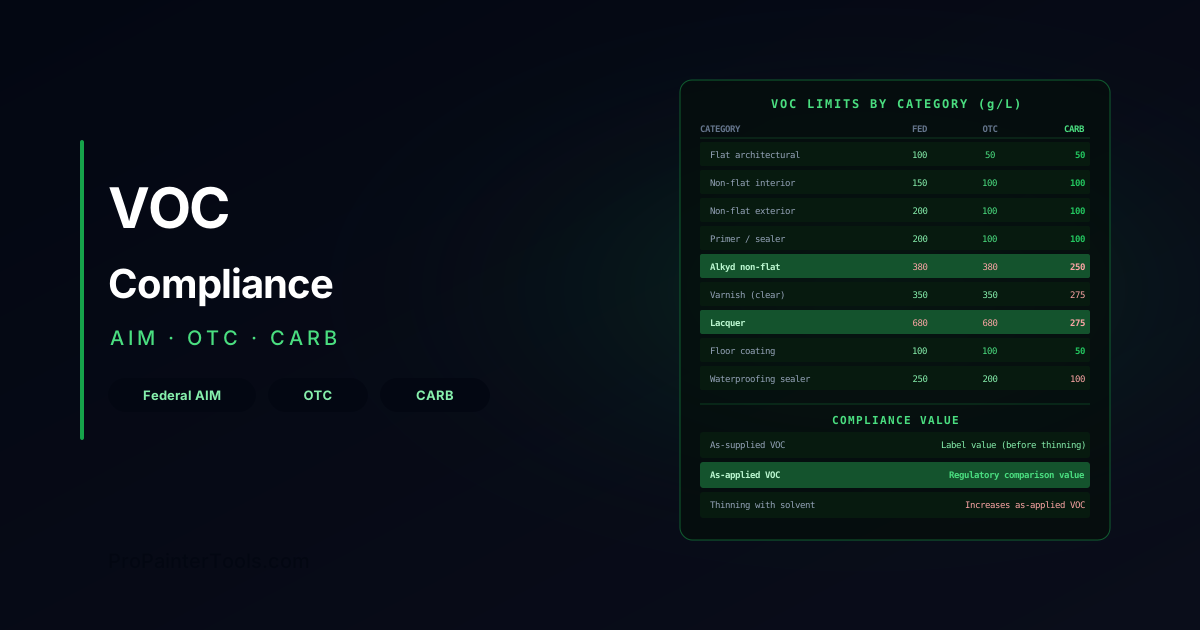
VOC Regulations for Painters: AIM Rule, CARB Limits, and Low-VOC Coatings
VOC compliance is a purchasing and specification decision, not just a legal formality. Contractors who do not understand which limits apply to their jurisdiction risk specifying non-compliant products, failing client or GC requirements, and — in restricted-air-quality areas — facing enforcement action. More practically, low-VOC formulations have proliferated to the point where performance differences with conventional products are minor for most applications, but real trade-offs exist in a small number of high-performance categories where understanding the chemistry matters. This guide covers the regulatory framework, how to read VOC values on product data sheets, and what the trade-offs actually are when moving from standard to low-VOC systems.
The Regulatory Framework
Federal AIM Rule (40 CFR Part 59): The US EPA's Architectural and Industrial Maintenance (AIM) coatings rule sets national VOC limits for architectural coatings. These are federal floor limits — states and air quality management districts can set stricter limits, but cannot go lower than the federal minimums.
OTC (Ozone Transport Commission): Applies to the Northeast US and mid-Atlantic states (Connecticut, Delaware, Maine, Maryland, Massachusetts, New Hampshire, New Jersey, New York, Pennsylvania, Rhode Island, Vermont, Virginia, and Washington DC). OTC limits are stricter than federal AIM limits for most categories.
CARB (California Air Resources Board): California consistently sets the strictest VOC limits in the country. CARB limits apply throughout California regardless of local air district. Many manufacturers formulate to CARB compliance to sell nationally without separate SKUs.
South Coast AQMD (Los Angeles region): The most restrictive jurisdiction in the country for some categories, with Rule 1113 applying even stricter limits than CARB on certain product types.
VOC Limits by Coating Category
| Coating Category | Federal AIM (g/L) | OTC (g/L) | CARB (g/L) |
|---|---|---|---|
| Flat architectural — interior/exterior | 100 | 50 | 50 |
| Non-flat architectural — interior | 150 | 100 | 100 |
| Non-flat architectural — exterior | 200 | 100 | 100 |
| Primer, sealer, undercoater | 200 | 100 | 100 |
| Alkyd/oil-based — non-flat | 380 | 380 | 250 |
| Varnish (clear) | 350 | 350 | 275 |
| Lacquer | 680 | 680 | 275 |
| Floor coating | 100 | 100 | 50 |
| Waterproofing sealer | 250 | 200 | 100 |
| Zinc-rich primer | 340 | 340 | 340 |
| Pre-treatment wash primer | 780 | 780 | 780 |
Reading this table: A flat latex that reads 45 g/L is CARB-compliant everywhere. A non-flat exterior latex at 150 g/L is federal-compliant but not OTC or CARB compliant. A standard oil-based varnish at 350 g/L is federal and OTC compliant but not CARB compliant.
As Supplied vs As Applied VOC
The VOC value printed on a can label is the as-supplied value — the VOC content of the product in the container before any thinning or mixing. This is not always the value that matters for compliance.
As applied VOC is calculated after thinning with water or solvent. If you thin a 90 g/L latex with water, the as-applied VOC per unit volume drops further (because you've diluted the product). If you thin a 200 g/L alkyd with mineral spirits, the as-applied VOC is higher than the label value because solvent thinner has its own VOC content.
The compliance value: Most regulations specify limits based on as-applied VOC content. Adding exempt solvents (acetone, water) doesn't change compliance status. Adding regulated solvents (mineral spirits, toluene, xylene) does — and can push a borderline product over the limit.
Practical rule: Do not thin any product with organic solvent without recalculating the as-applied VOC. For products already at or near the limit, thinning with anything other than water or exempt solvent is a compliance risk. The product's PDS will specify allowable thinners.
How to Read VOC on a Product Data Sheet
Product data sheets (PDS) present VOC in several formats. Common presentations:
- "VOC (as supplied): 48 g/L" — straightforward as-supplied value
- "VOC (less water and exempt solvents): 35 g/L" — the regulated VOC value; exempt solvents and water are subtracted before the g/L is calculated, as required by test method ASTM D3960
- "VOC: 0.4 lbs/gal" — US standard units; multiply by 120 to convert to g/L (e.g., 0.4 lbs/gal × 120 = 48 g/L)
- "Compliant: OTC / CARB / all jurisdictions" — manufacturer's compliance declaration; verify against the table above
The value used for regulatory comparison is always the ASTM D3960-measured value, net of water and exempt compounds.
Low-VOC vs Zero-VOC: Real Trade-Offs
"Low-VOC" (≤ 50 g/L) and "zero-VOC" (typically < 5 g/L or undetectable) are marketing terms that are broadly aligned with CARB compliance categories. For most architectural applications today — interior and exterior latex, primers — the performance of low-VOC formulations is essentially equivalent to higher-VOC predecessors. For a small number of high-performance categories, real trade-offs exist:
Waterborne alkyds (low-VOC alkyd technology): Dry faster and are low-odour, but typically have shorter open time than traditional oil-based alkyds, and may require longer re-coat windows to achieve equivalent cross-link density. Performance has improved significantly — most current waterborne alkyd technology performs within 10% of oil-based equivalents on hardness and block resistance.
Waterborne epoxy (two-component): Lower VOC than solvent-borne but typically requires higher ambient temperature for cure and is more sensitive to humidity during application. Solids by volume is generally equivalent. For floor coating in well-heated interior spaces, waterborne 2K epoxy is an appropriate choice. For low-temperature or high-humidity environments, solvent-borne systems still have an advantage.
Catalysed wood finishes (conversion varnish, 2K polyurethane): These are inherently high-VOC products by chemistry — the solvent system is integral to the resin delivery and cross-linking mechanism. Low-VOC alternatives (2K waterborne polyurethane) exist and perform well for cabinet work, but true conversion varnish has no equivalent low-VOC substitute. Clients in CARB jurisdictions requesting conversion varnish interiors must use waterborne 2K systems.
Zero-VOC latex: Flash-off time can be slightly longer because the solvent carrier is primarily water. In high-humidity conditions this extends dry-to-recoat time. Odour is minimal — appropriate for occupied buildings, healthcare, and sensitive environments.
For a full discussion of coating chemistry categories and how VOC relates to solids by volume and performance, see our professional coating guide. For the operational requirements of painting occupied commercial spaces — low-VOC protocols, LEED documentation, and night shift scheduling — see our commercial repaint guide.
Use ProPainterTools to document the VOC compliance of specified products on commercial jobs where the GC, owner, or LEED certification requires VOC documentation — this record is part of your project file.
Frequently Asked Questions
Do VOC limits apply to the painter or the manufacturer? Both. Manufacturers are responsible for formulating within limits. Contractors are responsible for not thinning products beyond compliance thresholds and for using compliant products in restricted jurisdictions. In California, a contractor who applies a non-CARB-compliant product is in violation regardless of who selected the product.
Do tinting bases affect VOC compliance? Yes. Deep-base paints have lower pigment content and can have higher VOC per litre than medium or pastel bases. Colorants added at the point of sale add VOC. A tinted paint's final VOC depends on the base VOC, the colorant VOC content, and the volume of colorant added. Manufacturers publish colorant VOC contribution data — request it for compliance-sensitive projects.
Is lacquer banned in California? Not banned, but regulated. CARB limits lacquer to 275 g/L (vs federal 680 g/L). Most conventional NC lacquers exceed 275 g/L. CARB-compliant lacquers exist but are specialty products. For kitchen cabinet work in California, waterborne 2K systems are the practical alternative.
What is an "exempt solvent" in VOC regulations? Acetone is the most common exempt compound in architectural coatings — it has low photochemical reactivity despite being a VOC by total organic content definition. Methyl acetate, PCBTF (parachlorobenzotrifluoride), and a small number of other compounds are also exempt under EPA and CARB rules. Water is not a VOC and is not a solvent for VOC calculation purposes.
